India is not one advertising market. It is a collection of markets shaped by different languages, cultures, media habits, festivals, purchase behaviours and local preferences.
A campaign that performs well in Delhi may require a different message in Chennai. A product benefit that appeals to customers in Mumbai may need different positioning in Kolkata, Hyderabad or Kochi. Simply translating one national advertisement into several languages is therefore rarely enough.
Successful regional language advertising combines language, cultural relevance, geographic targeting and media selection. It allows brands to maintain one central identity while making every local campaign feel as though it was created for that audience.
According to the IAMAI–Kantar Internet in India 2024 report, India had 886 million active internet users in 2024. Approximately 870 million had accessed the internet in Indic languages, while 57% of urban users said they preferred accessing internet content in Indic languages. Rural India also accounted for 488 million users, or 55% of the country’s active internet population.
For FMCG, fintech, ecommerce and consumer brands, regional communication is no longer an optional extension of the national campaign. It is an important part of reaching India’s next phase of customers.
Why Regional-Language Advertising Matters
People are more likely to understand and remember a message when it uses familiar language, expressions and cultural references.
Regional communication can help brands:
- Explain product benefits more clearly
- Build familiarity and local trust
- Reach customers beyond major metros
- Support new-city and new-state launches
- Improve engagement with regional media
- Make offers and calls to action easier to understand
Language, however, is only one component. Effective localization must also consider local behaviour.
For example, the same financial product may be presented around convenience for an urban professional, family security for a household audience or access and simplicity for a first-time digital user. The product remains the same, but the communication priority changes.
1. Build a Market-and-Language Map
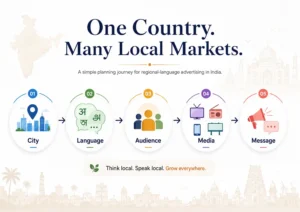
Begin by identifying the cities and states that matter most to the campaign.
For each market, document:
- Primary and secondary languages
- Audience demographics
- Product demand
- Retail or delivery availability
- Local media consumption
- Important festivals and events
- Competitor activity
- Relevant cultural considerations
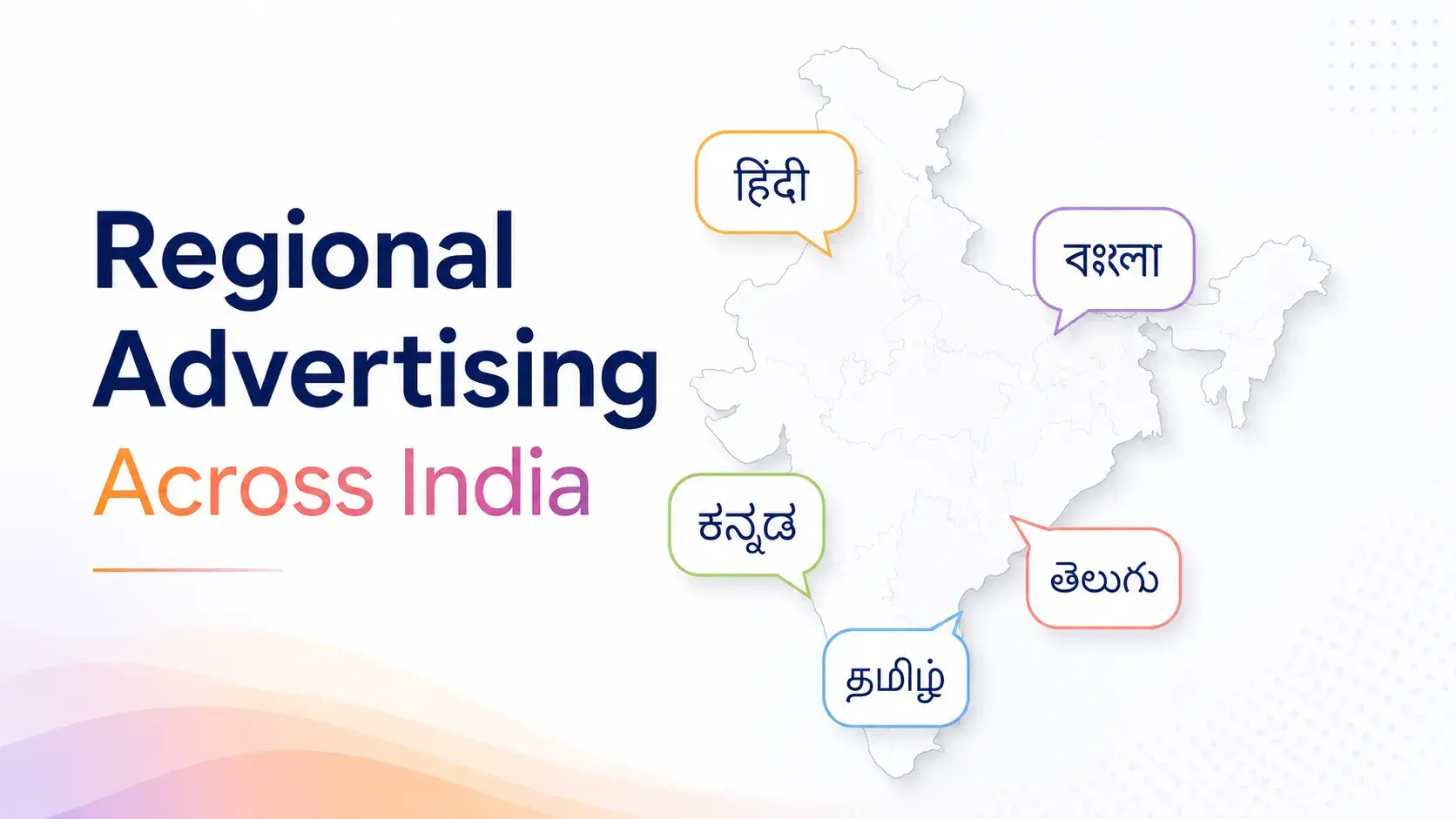
Avoid assuming that every state has only one language. Bengaluru campaigns may require Kannada, English or a combination of both. Hyderabad may need Telugu, English or Hindi depending on the audience. Mumbai campaigns may use Marathi, Hindi or bilingual communication.
The language decision should be based on the target customer and media environment, not geography alone.
2. Keep One Brand Idea but Localize Its Expression
A multi-city campaign needs one central brand proposition. This protects consistency across markets.
The campaign may revolve around affordability, convenience, health, speed, trust or product quality. That central message should remain stable, but its expression can change by region.
For example, a national food brand can retain the idea of “bringing families together” while adapting:
- The language
- Food references
- Family setting
- Regional casting
- Music
- Festival context
- Product usage occasion
This approach is more effective than creating completely unrelated campaigns for every city. It also prevents the brand from sounding identical and generic everywhere.
3. Localize More Than the Words
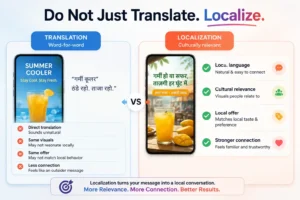
Direct translation can create awkward or inaccurate advertising. A grammatically correct sentence may still feel unnatural to a native speaker.
Strong localization should review:
- Tone and conversational style
- Local vocabulary and dialect
- Formal versus informal language
- Humour and wordplay
- Cultural references
- Colours, clothing and settings
- Voice-over pronunciation
- On-screen text length
- Calls to action
Social and mobile advertising may also require transliterated or code-mixed language. Some audiences may prefer Hindi written in the Roman alphabet, while others respond better to Devanagari. Tamil-English, Kannada-English and Telugu-English combinations may feel more natural in certain digital environments.
Use native copywriters, voice artists and regional reviewers. AI can support first drafts and language variations, but human validation remains necessary for cultural nuance and brand safety.
4. Select Media According to Regional Behaviour
A multilingual campaign should not use the same media mix in every city.
The right channel depends on audience behaviour, campaign objective and local media availability.
Regional television advertising can build mass awareness through entertainment, news, sports and language-specific channels. It is especially useful for FMCG, consumer products, fintech and ecommerce brands entering larger regional markets.
Radio advertising can provide high-frequency city-level reach through regional FM stations, local presenters, language-specific jingles and commute-time placements. EraZero supports campaigns across national and regional radio networks with city, language and demographic targeting.
OOH advertising can establish a physical presence in important neighbourhoods, shopping districts, transit routes and retail catchments. The creative should use fewer words and prioritise immediate readability in the chosen language.
For mobile audiences, JioSaavn in-app advertising can support language, geography, demographic and music-interest targeting through audio, video and display formats.
Brands can also use quick commerce advertising for city-specific sampling, inserts, coupons and carry-bag campaigns near active purchase environments.
5. Adapt the Creative to Each Media Format
One translated creative should not be resized and used everywhere.
A television commercial needs visual storytelling and natural dialogue. Radio requires a memorable voice, pronunciation and sound identity. A billboard needs a short message that can be understood within seconds. An in-app ad needs a direct benefit and action-oriented call to action.
Create a master campaign toolkit containing:
- Core campaign message
- Approved regional translations
- Regional visual references
- Short and long copy versions
- Voice-over scripts
- Format-specific calls to action
- Brand terminology guidelines
- Prohibited translations or phrases
This helps teams produce multiple regional assets without losing brand consistency.
6. Plan a Connected Multi-Channel Journey
Regional campaigns perform better when channels support one another.
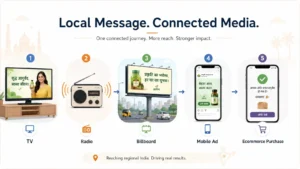
A consumer may first notice a local-language billboard, hear the campaign on regional radio, see a related mobile advertisement and finally purchase through an ecommerce platform.
An effective multi-channel advertising strategy gives each medium a specific role:
- TV creates broad awareness
- OOH establishes local visibility
- Radio builds frequency
- In-app advertising drives engagement
- Retail and quick commerce encourage action
- Digital retargeting supports conversion
The creative system should feel connected across these touchpoints, even when the message has been adapted for different formats.
7. Allocate Budgets by Market Potential
Avoid dividing the campaign budget equally across every city.
Allocate spending based on:
- Addressable audience
- Product availability
- Historical sales
- Competitive intensity
- Media costs
- Growth potential
- Campaign objective
- Local seasonality
A brand may use higher television and OOH investment in its priority states, while testing radio, in-app or quick-commerce campaigns in developing markets.
Start with a pilot across a small number of representative cities. Compare performance before expanding to additional languages and locations.
8. Measure Every Region Separately
A national average can hide major differences between markets.
Track performance by city, state, language, creative and channel. Relevant metrics include:
- Reach and frequency
- Video completion rate
- Audio listen-through rate
- Click-through rate
- Regional website traffic
- Branded search growth
- App installs
- Coupon or QR-code usage
- Store visits
- Sales by region
- Cost per acquisition
- Brand recall
Use unique landing pages, promotional codes, QR codes or geographic reporting to identify which language and media combinations are producing meaningful results.
9. Use AI to Coordinate Multi-City Campaigns
Running campaigns across several languages can create operational complexity. Every market may involve different media owners, creative versions, budgets, timelines and reporting formats.
AI media planning can help teams organise campaign requirements around geography, audience, objective, budget and media type.
EraZero brings television, radio, OOH, transit, print, cinema, retail, quick commerce and in-app opportunities into one AI-powered advertising platform. Its capabilities include media aggregation, hyperlocal targeting, campaign planning, creative generation and centralized management.
This allows brands to develop one strategic campaign while coordinating different regional executions more efficiently.
Plan Regional Advertising Campaigns with EraZero
Regional-language advertising is not about translating one English campaign into several scripts. It is about understanding what matters to customers in each market and building communication around their language, culture and media behaviour.
Brands that combine a consistent national identity with strong local relevance can build awareness, trust and action across India’s diverse markets.
With EraZero, brands can plan multi-city campaigns, explore media inventory, coordinate different advertising channels and build localized campaign strategies through one connected platform.