
An advertising campaign may generate millions of impressions, but how many people actually notice the advertisement?
This question is becoming increasingly important for CMOs, media buyers and marketing analysts. Impressions confirm that an ad was delivered. Viewability confirms that it had an opportunity to appear on a screen. Clicks show that some users took an immediate action. None of these metrics, however, fully explains whether the audience paid attention to the message.
This is where attention metrics in advertising add value.
Attention measurement helps marketers understand whether an advertisement was likely to be seen, heard, processed or engaged with. It does not replace reach, conversions or sales measurement. It adds another layer between media delivery and business outcomes.
The IAB and Media Rating Council released finalized attention-measurement guidelines in November 2025 to create greater consistency across digital and cross-media environments. The framework covers data signals, visual and audio tracking, physiological observation, and panel or survey-based methods.
Why Impressions Are No Longer Enough
An impression generally confirms that an advertisement was served. It does not necessarily mean the user looked at it, listened to it or remembered it.
A mobile display ad may load while the user scrolls past it. A video may play while the viewer looks at another screen. A billboard may be located on a busy road but have poor visibility because of traffic direction, clutter or a difficult viewing angle.
This creates an important distinction:
Delivered does not always mean seen. Seen does not always mean noticed. Noticed does not always mean remembered.
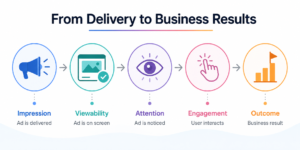
Campaign measurement must therefore examine the complete path:
Delivery → Viewability → Attention → Engagement → Outcome
Attention metrics help brands evaluate the middle of this journey.
Viewability vs Attention: What Is the Difference?
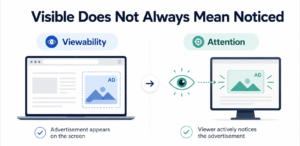
Viewability measures whether an advertisement had the opportunity to be seen.
For digital advertising, the widely used MRC benchmark considers a display ad viewable when at least 50% of its pixels are visible for at least one continuous second. For video, the common benchmark is 50% of pixels for at least two continuous seconds.
However, a viewable advertisement may still receive little attention.
A user may have the ad on screen while focusing on other content. Viewability measures the availability of the advertisement; attention measurement estimates whether the person actually noticed or engaged with it.
The IAB describes attention as a complementary layer rather than a replacement for viewability or campaign outcomes.
What Are Attention Metrics in Advertising?
Attention metrics are signals used to evaluate the quality and duration of audience attention.
Depending on the medium and measurement provider, these may include:
- Attentive seconds
- Attention rate
- Time in view
- Percentage of video watched
- Audible time
- Screen position
- Scroll behaviour
- Mouse or touch interaction
- Eye-tracking signals
- Facial orientation
- Brand recall
- Survey-based engagement
Not every campaign needs every metric. Brands should select signals that match the media format, campaign objective and available measurement technology.
For example, audible time may matter for a video or audio campaign, while dwell time, viewing angle and audience presence may be more useful for OOH advertising.
The Most Useful Attention Metrics for Advertisers
1. Attentive Time
Attentive time estimates how long an advertisement held a viewer’s attention.
This can help compare two placements that delivered similar impression volumes. One may generate longer attention because of better positioning, stronger content or a less cluttered environment.
Attentive time should be considered alongside creative length. A six-second ad and a 30-second ad cannot always be compared using total seconds alone.
2. Attention Rate
Attention rate represents the proportion of measurable impressions that received a defined level of attention.
It can help media buyers compare placements, formats or audiences. However, brands must understand how the measurement provider defines an attentive impression before using the result.
Different vendors may use different signals and models. Transparent methodology is therefore essential.
3. Attentive Seconds per Thousand Impressions
This metric combines attention quality with media scale. It estimates how much attentive time a campaign generates for every thousand impressions delivered.
It can help brands avoid choosing inventory solely because it offers a low cost per thousand impressions. A low-cost placement may be less valuable if audiences rarely notice the advertisement.
4. Video Completion and Audible Exposure
Video completion rate shows how much of a video advertisement was played, but completion alone does not prove attention.
A stronger assessment may combine:
- Percentage viewed
- Audible-on duration
- Full-screen exposure
- User interaction
- Active screen presence
For in-app advertising, brands can compare banner, native, interstitial and video formats to understand which placements create stronger opportunities for attention.
5. Creative Attention
Attention is influenced not only by the media placement but also by the advertisement itself.
Creative attention analysis can examine:
- How quickly branding appears
- Whether the product is clearly visible
- Message simplicity
- Visual hierarchy
- Movement
- Contrast
- Human faces
- Call-to-action visibility
A placement may offer strong attention potential, but weak creative can still fail to communicate the message.
How to Build an Attention-Measurement Framework
Step 1: Start with the Business Objective
Do not introduce attention metrics simply because they are new.
First determine whether the campaign is intended to increase awareness, consideration, store visits, app installs, leads or sales.
Attention should then be connected to an appropriate outcome. For example, a brand-awareness campaign may compare attention with recall, while a performance campaign may compare it with conversions or cost per acquisition.
Step 2: Establish Delivery and Viewability Quality
Before evaluating attention, confirm that the campaign delivered correctly.
Review:
- Valid impressions
- Viewable impressions
- Invalid traffic
- Placement quality
- Audience delivery
- Frequency
- Device and format performance
Attention cannot repair poor delivery or unsuitable targeting.
Step 3: Compare Media, Placement and Creative Separately
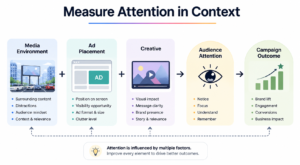
A campaign’s attention performance may be affected by three major factors:
- The surrounding media environment
- The position and format of the advertisement
- The strength of the creative
The IAB/MRC framework specifically identifies content, placement and creative as important areas that should be assessed when evaluating attention.
Marketers should avoid assuming that one attention score represents the entire reason for campaign performance.
Step 4: Connect Attention with Outcomes
Attention should not become the final campaign KPI.
Compare higher-attention placements and creatives with:
- Brand recall
- Search lift
- Website visits
- Store visits
- Leads
- App installs
- Conversions
- Sales lift
- Return on ad spend
The finalized industry guidelines state that attention is not intended to replace conversion, sales-lift or brand-impact measurement. It should be used with outcome metrics and validated evidence.
Applying Attention Measurement Across Media
Attention does not look the same across every channel.
For OOH and DOOH, brands may consider location, traffic speed, audience presence, screen visibility, dwell time and contextual relevance.
For television and video, useful signals may include completion, audible exposure, active viewing and creative recall.
For mobile and in-app campaigns, attention may be influenced by screen coverage, format, interaction, scroll behaviour and the surrounding app environment.
A connected multi-channel advertising strategy should therefore avoid using one identical attention benchmark across all media.
Each channel should have an appropriate measurement method while still contributing to a unified campaign objective.
Common Attention-Measurement Mistakes
Brands should avoid:
- Treating attention as a guaranteed business outcome
- Comparing scores from different vendors without checking methodology
- Ignoring creative quality
- Optimizing only for the longest attention duration
- Measuring attention without audience relevance
- Using intrusive tracking without appropriate privacy controls
- Replacing sales or brand-lift metrics with one attention score
Longer attention is not automatically better. Confusing, irritating or misleading advertising may also hold attention without producing a positive brand response.
Improve Campaign Effectiveness with EraZero
EraZero helps brands plan advertising across OOH, DOOH, in-app, transit, television, radio, cinema, retail, print and other media through one AI-powered advertising platform.
Through AI media planning, marketers can compare campaign objectives, audiences, locations and media formats more systematically.
Attention data can strengthen this process by helping teams identify which placements and creatives are more likely to be noticed. When combined with reach, targeting, conversions and business outcomes, attention metrics can help brands move from simply buying exposure to building more effective advertising experiences.