There’s a familiar mistake in outdoor advertising.
A marketing team asks for the “best billboard locations” in a city. Someone opens a spreadsheet. Another person calls media owners. A shortlist appears with famous roads, major junctions and premium billboards.
And then everyone starts discussing rates.
But one important question hasn’t really been answered:
Why should your audience see your brand at those locations?
The busiest road in Mumbai isn’t automatically the best location for every brand. A massive billboard near an airport may be valuable for one campaign and completely unnecessary for another. A smaller placement close to your stores, target residential areas or customer commute routes may sometimes do much more useful work.
That’s where OOH location planning is changing.
Instead of beginning with a list of available billboards, marketers can increasingly begin with the audience, campaign objective and geography — and use AI location intelligence to narrow down where outdoor advertising should actually appear.
EraZero AI is built around that approach. Its AI media planning workflow lets marketers describe their target audience and campaign objective, receive media and OOH location recommendations, explore available inventory and move from planning towards execution without relying entirely on disconnected spreadsheets and manual searches.
The result isn’t simply faster billboard booking.
It’s a better way to answer the question every OOH campaign should start with:
Where does this brand genuinely need to be seen?
1. Why OOH Location Planning Is Harder Than It Looks
Traditional outdoor planning often starts with inventory.
A planner receives a spreadsheet containing hundreds of hoardings, unipoles, gantries, bus shelters or digital screens. Each may include a location, dimensions, photographs and pricing.
Useful? Absolutely.
Enough to make a good media decision? Not really.
A premium location isn’t automatically a relevant location
Imagine you’re opening a premium fitness studio in one part of Mumbai.
You could buy a huge billboard on a famous road simply because it receives substantial traffic.
Or you could concentrate your campaign around:
- residential catchments where prospective members live;
- corporate hubs where they work;
- commuting corridors connecting those areas;
- premium cafés, malls and lifestyle districts;
- locations close enough for someone to realistically visit the studio.
The second strategy may generate fewer total exposures on paper.
But those exposures could be far more relevant.
That’s the difference between buying visibility and planning visibility.
The old process creates too many disconnected decisions
A marketing manager may have to consider:
- Which neighborhoods contain the target audience?
- Where does that audience commute?
- Which roads offer suitable visibility?
- What OOH formats are available there?
- Should the campaign use billboards, DOOH, transit or several formats?
- How much geographic coverage is actually necessary?
- Does the creative make sense in that environment?
- Is the inventory available during the campaign period?
When those decisions live across emails, vendor sheets, maps and separate presentations, location planning becomes slower and increasingly dependent on instinct.
AI can help connect those decisions earlier.
2. What AI Location Intelligence Changes in OOH Planning
AI location intelligence doesn’t mean asking an algorithm for “the best billboard in Mumbai” and blindly purchasing whatever appears first.
The more useful idea is to give AI enough context to narrow the search intelligently.
Start with people, not pins on a map
A strong OOH planning brief might say:
Launching a premium skincare brand in Mumbai. Primary audience is working women aged 25–40. Focus on awareness around premium shopping, residential and corporate areas.
That’s much more useful than:
Show me billboards in Mumbai.
EraZero’s conversational planning workflow is designed around this approach. Marketers can give Steve AI their target audience and campaign objective, after which the platform can suggest relevant media opportunities and OOH locations before available inventory is selected.
That changes the sequence.
Traditional approach:
Available inventory → locations → audience fit
AI-led approach:
Audience → objective → geography → suitable locations → available inventory
The difference looks small.
Strategically, it’s huge.
AI helps reduce the search space
A city can contain thousands of potential advertising environments.
You don’t need all of them.
You need the subset that makes sense for your particular campaign.
AI-assisted planning can help marketers think about factors such as:
- target geography;
- campaign objective;
- audience profile;
- OOH format;
- location context;
- visibility;
- available inventory;
- estimated reach;
- opportunities for hyperlocal concentration.
EraZero’s DOOH offering specifically describes screen discovery based on factors including location, audience profile, campaign objective, visibility and media format, along with location-based targeting across environments such as malls, airports, transit areas and commercial zones.
3. How to Select OOH Locations with EraZero AI
The easiest way to use EraZero isn’t to start by browsing every available outdoor site.
Start with the campaign problem.
Step 1: Give Steve AI a useful campaign brief
Tell Steve AI what you’re actually trying to accomplish.
Include details such as:
- brand or product category;
- campaign objective;
- target city;
- target audience;
- important neighborhoods or catchments;
- campaign duration;
- approximate budget;
- preferred formats, if any;
- whether you’re seeking broad reach or hyperlocal targeting.
For example:
We’re launching three premium grocery stores in Mumbai and want awareness and footfall among affluent families and working professionals within the surrounding catchments.
That gives AI something meaningful to work with.
Step 2: Let the campaign objective shape geography
Not every objective needs the same location strategy.
For brand awareness, you may prioritize highly visible corridors and repeated exposure.
For retail footfall, proximity becomes more important.
For real estate, the relevant catchment around a project can matter far more than city-wide exposure.
For product launches, a combination of premium high-visibility zones and target-audience environments may work better.
EraZero’s own Bengaluru hyperlocal real-estate example focused campaign activity within a roughly 4–5 km residential catchment and used several OOH formats to build repeated local exposure rather than spreading the campaign indiscriminately across the city.
Step 3: Review the recommended OOH opportunities
EraZero’s AI media planning workflow can move from the brief to recommended media and OOH locations.
Instead of looking at every location available in the market, you can begin examining the placements that align more closely with the campaign.
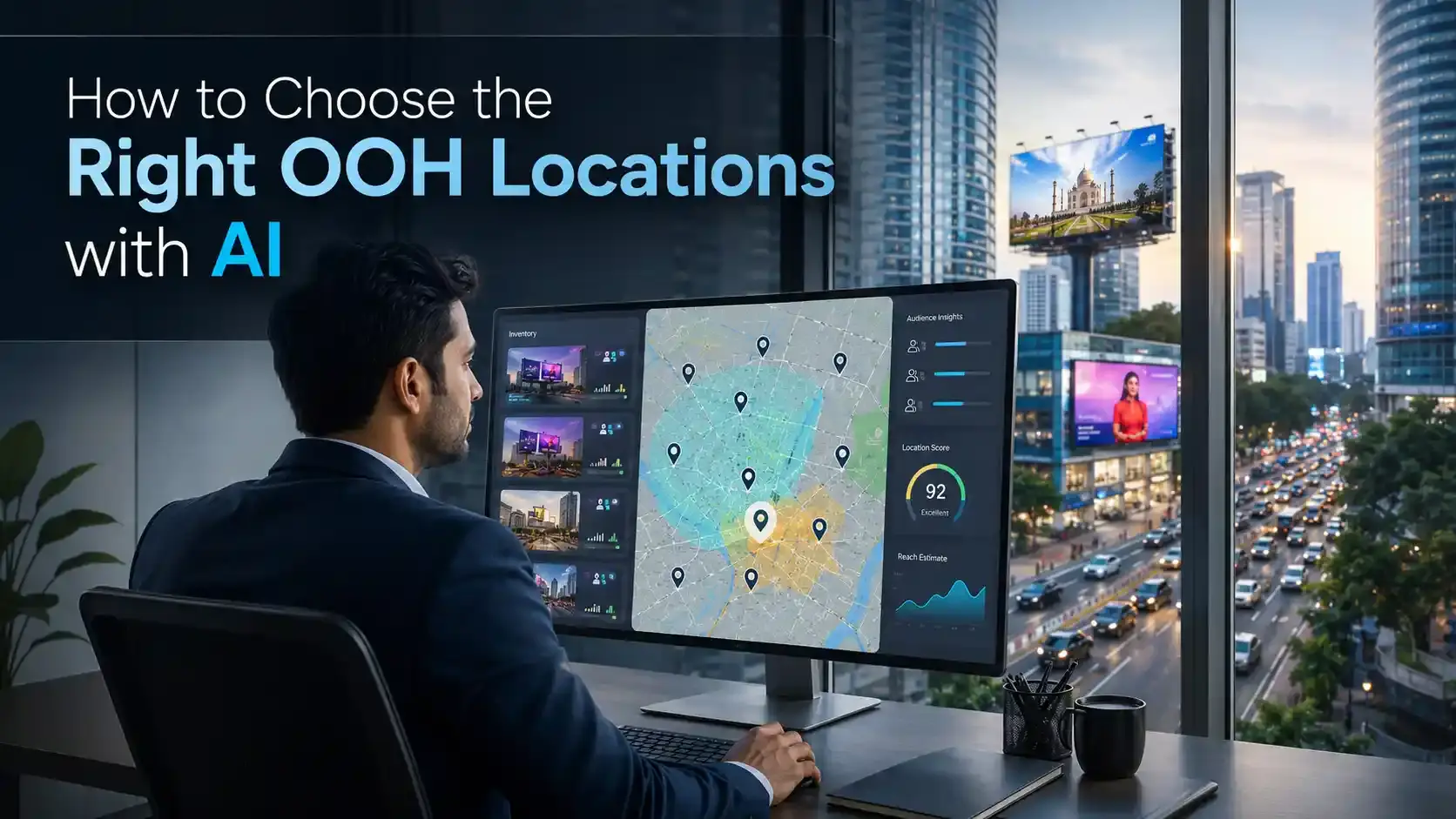
The platform’s current AI Media Planning interface also presents OOH inventory discovery through an inventory explorer and map-based planning experience, including inventory and estimated-reach information.
This is where a marketer should start asking better questions:
- Is this location close to my target audience?
- Is my audience likely to pass through it repeatedly?
- What are they doing when they see the advertisement?
- Is the placement visible long enough for the message?
- Does the media format suit the environment?
- Does this location complement the other sites in the plan?
Don’t evaluate a pin independently.
Evaluate the role it plays inside the campaign.
4. What Actually Makes an OOH Location “Right”?
This is where OOH planning becomes interesting.
The best location isn’t necessarily the one with the largest billboard, most traffic or highest rate card.
Think of location quality as a combination of:
Audience relevance × context × visibility × repetition × proximity to action
Audience relevance comes first
Ask who you’re paying to reach.
A B2B SaaS company might value:
- technology corridors;
- corporate parks;
- airports;
- premium business districts.
A family retail brand might care more about:
- residential neighborhoods;
- malls;
- supermarkets;
- weekend shopping corridors.
A youth-focused consumer brand could lean towards:
- colleges;
- entertainment districts;
- malls;
- metro routes;
- high-street destinations.
The physical location is only useful when it overlaps with the people you care about.
Context changes the value of the impression
Where someone sees your message influences how they interpret it.
A food brand near a lunch-heavy office district has contextual relevance.
A real-estate campaign near a project catchment has geographic relevance.
A fashion campaign around premium malls has shopping relevance.
A travel brand at an airport has journey relevance.
The billboard doesn’t exist separately from its surroundings.
Its surroundings are part of the media.
Repetition can matter more than one spectacular site
One enormous billboard can create impact.
A coordinated network can create familiarity.
For many campaigns, repeated exposure across a person’s normal journey can be more strategically useful than a single isolated placement.
Think:
Home → commute → office → shopping → commute → home
Where can the brand naturally appear more than once?
This is where OOH location planning starts becoming audience-journey planning.
5. How Hyperlocal Targeting Makes OOH More Precise
For years, outdoor advertising was sometimes treated as a broad-reach medium.
Buy a famous junction. Cover a city. Hope enough relevant people see the campaign.
That model still has its place.
But hyperlocal targeting creates another option.
You don’t always need the whole city
Suppose a retail brand has eight stores.
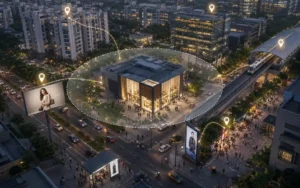
A city-wide campaign may sound impressive, but the brand might get more useful visibility by developing individual catchments around each store.
For every catchment, you could consider:
- nearby residential clusters;
- office districts;
- major approach roads;
- metro stations;
- retail hubs;
- shopping areas;
- high-frequency commuter routes.
Now OOH isn’t merely saying:
“We’re everywhere.”
It’s saying:
“We’re visible where our customers actually are.”
EraZero positions hyperlocal targeting as one of its platform capabilities and describes OOH/DOOH planning around specific neighborhoods, commercial areas, malls, transit zones, airports and other high-footfall environments.
Think in clusters instead of individual billboards
A useful hyperlocal campaign rarely starts with:
“Which single hoarding should we buy?”
A better question is:
“Which group of locations gives us meaningful coverage of this audience?”
For example, a retail cluster might include:
- one high-impact entry-road billboard;
- one DOOH screen near a shopping destination;
- transit visibility along a key commuter route;
- additional visibility closer to the store.
Each placement has a different job.
Together, they build frequency.
6. Different Brands Need Different OOH Location Strategies
There’s no universal list of the “top 10 OOH locations.”
The right answer changes with the brand.
Retail brands should plan around the path to the store
For a retail marketer, AI location intelligence can help shift the conversation from maximum reach to useful reach.
Prioritize environments such as:
- store catchments;
- shopping districts;
- premium residential areas;
- commuter routes approaching stores;
- malls and complementary retail environments.
A brilliant billboard 25 kilometres away may have less commercial value than a smaller placement repeatedly seen by people living five minutes from the store.
Marketing managers should connect location to the campaign objective
Before approving an OOH plan, ask:
- What is each location supposed to accomplish?
- Which audience does it help us reach?
- How does it support the overall campaign?
- Are we creating enough frequency?
- Are we paying for geography that doesn’t matter?
A location shouldn’t appear in a media plan simply because someone labelled it “premium.”
It should earn its place.
Agencies can use AI to speed up multi-location planning
Agency teams face a different problem: scale.
One client may want Bengaluru.
Another wants Mumbai, Delhi NCR and Hyderabad simultaneously.
Each market can involve different vendors, inventory, formats and local considerations.
EraZero’s OOH automation offering is positioned around AI-powered campaign planning, automated location recommendations, inventory discovery and multi-location campaign workflows — reducing some of the manual research and coordination associated with traditional planning.
That can give planners more time for the part that still needs human judgement:
strategy.
The Biggest OOH Location Planning Mistakes to Avoid
AI can speed up location discovery, but the quality of the brief still matters.
Watch out for these common mistakes:
Choosing only the busiest locations
High traffic doesn’t automatically equal high audience relevance.
Buying locations independently
A group of disconnected “good sites” isn’t necessarily a good media plan.
Look for coverage, sequence and repetition.
Targeting an entire city when the business is hyperlocal
If your customers come primarily from five neighborhoods, don’t automatically pay to reach fifty.
Ignoring the environment around the billboard
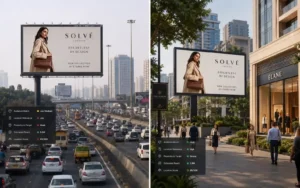
The same creative can behave very differently beside a mall, corporate park, highway or residential neighborhood.
Treating the biggest format as the best format
A huge static billboard isn’t always better than a strategically placed DOOH screen, bus shelter or other contextually relevant format.
Giving AI a vague brief
“Give me the best billboards in Bengaluru” will always be a weaker starting point than:
“Recommend OOH opportunities for a premium D2C brand targeting young professionals around Bengaluru’s major corporate and lifestyle districts.”
Better input creates better planning.
Choose the Audience First. Let the Location Follow.
Outdoor advertising has never suffered from a lack of locations.
The difficult part has always been deciding which locations deserve your budget.
That’s why the most useful shift in modern OOH planning isn’t simply moving billboard inventories online.
It’s changing where the decision begins.
Instead of:
“Which billboards are available?”
Start with:
“Who are we trying to reach, where do they move, and where should our brand enter that journey?”
Then use AI to narrow the possibilities.
EraZero brings conversational AI planning, OOH location recommendations, inventory discovery, hyperlocal targeting and campaign execution into a more connected workflow. That helps marketing managers, retail brands and agencies spend less time sorting through locations that don’t matter and more time building campaigns around the ones that do.
Your next step
Before planning your next OOH campaign, write down these five things:
- Your audience
- Your campaign objective
- Your target geography
- The action you want people to take
- The places your audience repeatedly lives, works, travels or shops
Then take that brief into EraZero AI and start the location-planning process from the audience outward — not from the billboard inward.
Plan smarter. Shortlist relevant locations. Build an OOH campaign around where your audience actually is.