Transit advertising gives brands something static media cannot: movement.
A metro train can dominate a high-density commuter corridor. A full-wrap bus can carry a campaign across several neighbourhoods. A branded cab can move through offices, airports, residential areas and shopping districts throughout the day.
But that creates a planning problem.
Should your campaign use metro advertising, bus advertising or cab branding?
The answer depends less on which format looks biggest and more on who you need to reach, where they move, how often you want them to see the campaign and how concentrated your geography needs to be.
For media planners and local brands, understanding the difference between these three major transit media formats can prevent a lot of wasted budget. EraZero currently supports transit media such as full bus wraps and side panels, metro train branding and route-optimized mobile formats as part of its wider outdoor advertising platform.
Metro Advertising: Best for Scale and Repeated Commuter Exposure
If your campaign needs large urban visibility, metro advertising is usually the strongest of the three formats.
A full or partial metro wrap turns an entire train into a moving advertising asset. Inside stations, brands can also use platform panels, digital screens, concourse branding, entry and exit media, escalators and installations.
EraZero’s metro advertising offering includes exterior and interior train wraps, with route-based planning and audience targeting across high-density urban corridors.
Metro works particularly well when you want to reach:
- office commuters;
- urban professionals;
- students;
- shoppers;
- fintech and app users;
- premium consumer audiences.
The main advantage is frequency.
People often take the same metro route every day. That means a campaign can build recognition through repeated exposure rather than relying on one accidental viewing.
Metro is especially strong for:
- product launches;
- fintech;
- automotive;
- OTT and entertainment;
- real estate;
- consumer technology;
- large retail brands.
But metro is usually less flexible for hyperlocal campaigns. If your business wants to reach three neighbourhoods rather than an entire commuter corridor, another transit format may be more efficient.
Bus Advertising: Best for Broad City Coverage
The biggest difference in metro advertising vs bus advertising is how the media moves through the city.
Metro follows a fixed rail corridor.
Buses travel through roads, neighbourhoods, commercial districts, residential areas and transport hubs.
That gives bus advertising wider street-level exposure.
EraZero’s transit-media ecosystem includes full bus wraps and side-panel advertising, making buses suitable for brands that want a large moving canvas with broad city visibility.
A full-wrap bus can work particularly well for:
- FMCG;
- retail;
- ecommerce;
- education;
- healthcare;
- entertainment;
- local consumer brands.
The creative opportunity is also significant.
A bus has enough physical space to show a product, lifestyle scene or bold visual concept at scale.
Think of the difference this way:
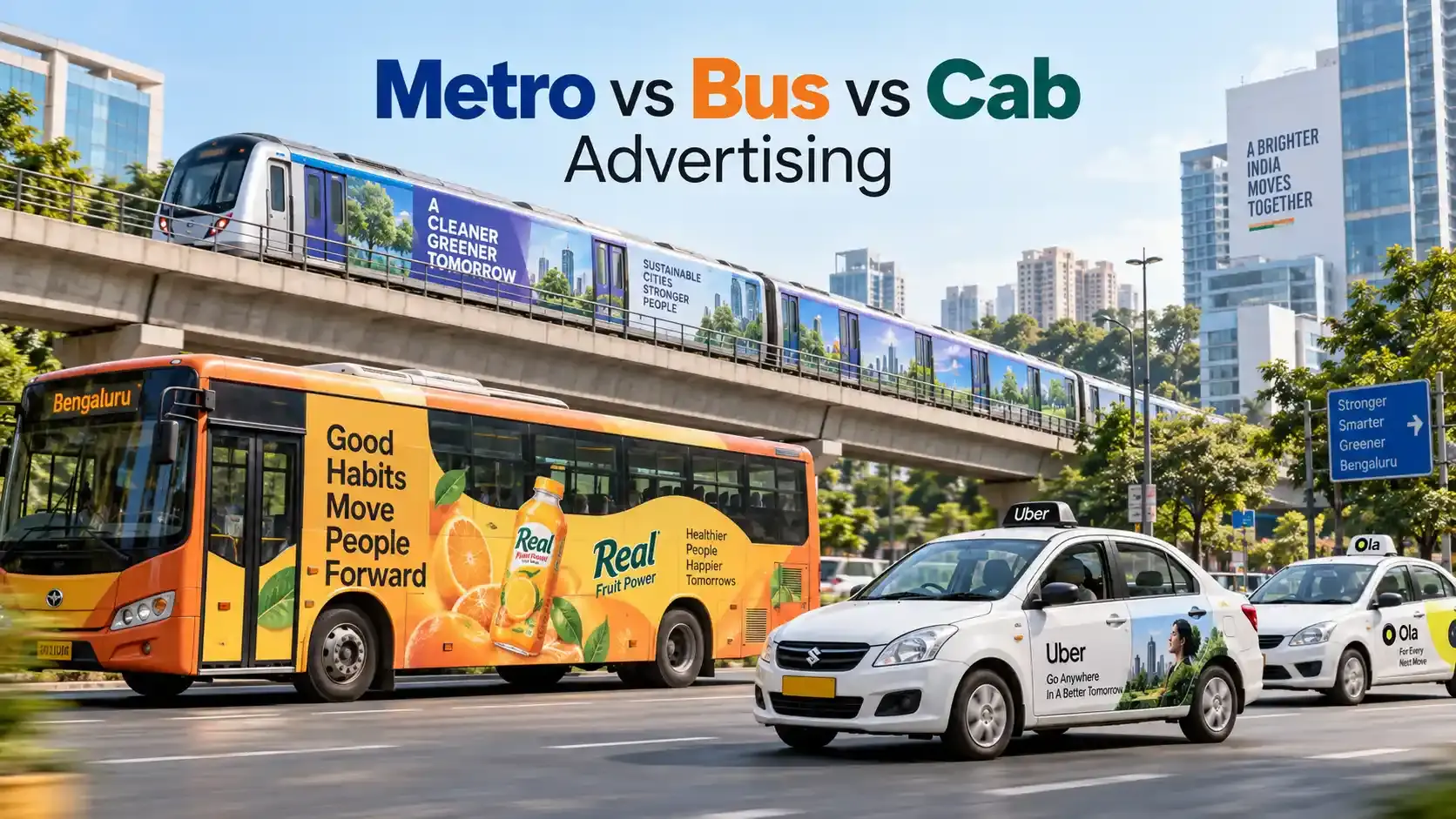
Metro = concentrated commuter corridor
Bus = moving neighbourhood coverage
Brands can also complement moving bus campaigns with bus shelter advertising. Bus shelters offer something buses themselves do not: dwell time. People waiting at a shelter have more time to read an offer, scan a QR code or absorb a slightly more detailed message. EraZero supports static, backlit, digital and 3D bus-shelter formats with location-level targeting.

Cab Branding: Best for Flexible and Hyperlocal Urban Reach
Cab branding behaves differently from both metro and bus advertising.
A cab isn’t tied to one railway line or one fixed public transport route.
It can move between:
- airports;
- IT corridors;
- commercial districts;
- residential zones;
- malls;
- hotels;
- entertainment areas.
EraZero supports full cab wraps, door panels, 3D cab branding and in-cab advertising, alongside route planning, zone targeting and fleet optimization.
This makes cab advertising particularly useful for brands that need mobility and geographic flexibility.
For example, a D2C company targeting young professionals could concentrate branded cabs around technology parks and premium residential catchments.
A travel brand could focus on airport routes.
A restaurant or retail chain could deploy fleets around selected store clusters.
Cab branding is especially strong for:
- startups;
- D2C;
- fintech;
- ecommerce;
- food delivery;
- local retail;
- entertainment.
It is also one of the most creative outdoor advertising formats because brands can go beyond simple door panels and experiment with full wraps or 3D product installations. EraZero’s OOH guidance similarly identifies bus, cab and metro wraps as useful moving formats for reaching urban audiences.
Metro vs Bus vs Cab: Which Should You Choose?
A simple way to decide is to connect the format to the campaign job.
| Campaign Need | Best Fit |
| Massive commuter visibility | Metro |
| Repeated urban exposure | Metro |
| Broad road and neighbourhood coverage | Bus |
| Large moving creative canvas | Bus |
| Hyperlocal targeting | Cab |
| Flexible route deployment | Cab |
| Airport and business corridors | Cab |
| Large brand launch | Metro or Bus |
| Local retail campaign | Cab or Bus |
| Premium city audience | Metro or Cab |
But don’t choose only by format.
The same bus, cab or metro campaign can perform very differently depending on route, location and audience fit.
A metro campaign on the wrong line is still the wrong campaign.
A fleet of 100 cabs scattered randomly across a city may be less useful than 30 cabs concentrated around your actual audience.
A large bus wrap might create visibility but fail if the route never gets close to the market you’re trying to influence.
Don’t Forget Creative Fit
Another overlooked factor is the creative itself.
A metro train can support long-form visual storytelling across multiple coaches.
A bus gives brands a broad physical surface for large-scale visuals.
A cab needs faster recognition because people may see it for only a few seconds.
That means one artwork shouldn’t simply be resized across every format.
EraZero’s guidance on OOH format selection recommends matching the format to both the audience and the viewing environment rather than treating all outdoor media as interchangeable.
How EraZero AI Helps Plan Transit Campaigns
EraZero AI brings transit media, OOH and other advertising channels into one planning environment.
Instead of starting with whichever vehicle inventory a vendor sends, marketers can begin with:
- campaign objective;
- target audience;
- city;
- budget;
- relevant locations;
- media format.
EraZero then supports route planning, location selection, inventory discovery and centralized campaign execution across transit and outdoor formats. Its platform is designed to combine OOH, transit and digital channels rather than requiring teams to manage each medium separately.
For planners, that’s the important shift.
Don’t start with:
“Should we buy buses, metros or cabs?”
Start with:
“Where does our audience move, and what kind of visibility do we need?”
Then choose the vehicle.