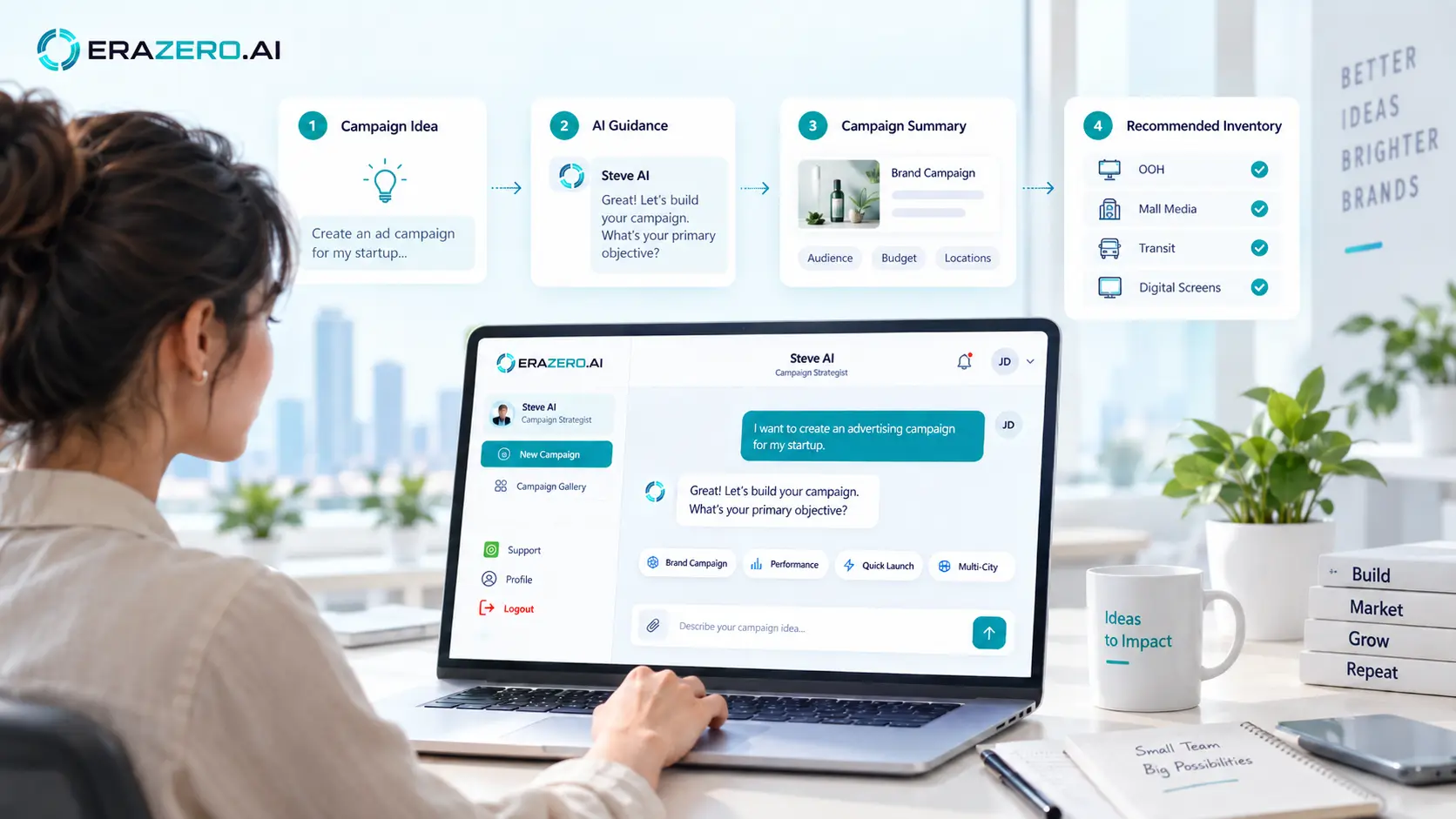
A startup usually doesn’t have a media planner, audience strategist, inventory specialist, campaign coordinator and growth analyst sitting in five different seats.
Sometimes they’re all one person.
The founder is thinking about product. The growth lead is checking CAC. Someone from marketing is trying to figure out where to advertise. And somewhere in the middle of all that, a campaign still needs to be planned.
That’s where AI advertising for startups starts to become genuinely useful.
Not because AI magically replaces the entire marketing team.
Because it can take a messy campaign idea and help turn it into something structured enough to actually execute.
On the EraZero AI platform, Steve AI acts as a campaign strategist. A startup can begin with a simple description of what it wants to achieve, then work through campaign objectives, audiences, locations, budgets and media choices before reviewing recommended advertising inventory.
The process feels less like filling out a complicated media-planning spreadsheet and more like having a conversation with someone who knows what information the campaign needs next.
Here’s how it works.
Why Startup Advertising Becomes Complicated So Quickly
Running an ad campaign sounds simple when written on a whiteboard.
Goal → Audience → Media → Launch.
In practice, every one of those steps creates more questions.
A founder might know:
“We want more people in Bengaluru and Mumbai to know our brand.”
But then comes everything else.
- What should the actual campaign objective be?
- Who exactly should the campaign target?
- Which cities should get more budget?
- Should the brand use OOH, mall media or another channel?
- How long should the campaign run?
- Which individual advertising locations make sense?
- What does the available inventory cost?
- How much reach does each location offer?
- Which placements fit the final budget?
Large advertisers often have agencies and specialist teams to work through those decisions.
Startups usually don’t.
That’s why startup marketing AI becomes useful when it helps structure these decisions rather than simply generating another marketing idea.
Steve AI is designed around that planning problem.
1. Start With Steve AI Instead of a Blank Media Plan

The EraZero AI workflow starts with Steve AI.
Instead of opening a complex campaign form, marketers are presented with a simple prompt:
Describe your campaign goals, target audience, budget…
That’s important for startups because the starting point doesn’t require a fully developed media plan.
You can begin with what you already know.
For example:
We want to create a campaign for our food brand. The goal is to build awareness and product consideration among urban consumers in Mumbai and Bengaluru.
You can include information such as:
- brand name;
- website;
- campaign objective;
- target customer;
- preferred cities;
- approximate budget;
- product or service being promoted.
Steve then takes that initial brief and begins building the campaign with you.
The interface also provides different campaign entry points such as Brand Campaign, Performance, Quick Launch and Multi-City, making it easier to start from the type of campaign you’re trying to run.
For a small growth team, that’s much less intimidating than beginning with dozens of media-planning fields.
2. Build the Campaign Through a Conversation
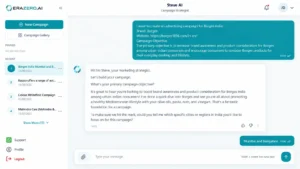
This is where the experience becomes more useful.
Steve doesn’t simply accept the initial prompt and disappear.
It asks for the missing information needed to build the campaign.
In the example shown on EraZero, the marketer explains that the objective is to increase brand awareness and product consideration.
Steve recognizes the objective and then asks the next practical question:
Which cities or regions should the campaign focus on?
The marketer answers:
Mumbai and Bangalore.
That conversational approach matters because founders don’t always know every field required for media planning in advance.
A traditional form expects you to know what to enter.
Steve AI helps you work out what still needs to be decided.
The campaign gets clearer one decision at a time
A typical startup planning conversation can move through:
Campaign objective
What should the advertising accomplish?
Location
Which cities or geographic markets matter?
Audience
Who should actually see the campaign?
Budget
How much can the startup spend?
Media mix
Which advertising formats should be considered?
Campaign period
How long should the activity run?
This is a much more natural way to use campaign launch AI.
You’re not asking AI to “make a campaign.”
You’re using AI to progressively build a better brief.
3. Steve Turns the Conversation Into a Structured Campaign Brief
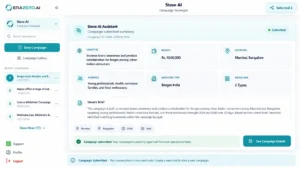
Once enough information has been collected, Steve converts the conversation into a structured campaign summary.
In the example, the campaign is organized into clear sections for:
- Objective
- Budget
- Location
- Audience
- Industry Type
- Media Mix
Steve also creates a concise campaign brief describing what the campaign is trying to achieve and who it is intended to reach.
This is one of the biggest benefits of AI advertising for startups.
A founder may begin with something fairly broad:
“We want more people to know our brand.”
But by the end of the planning process, that has become something much more actionable:
Objective: Increase brand awareness and product consideration
Audience: Young professionals, health-conscious families and food enthusiasts
Locations: Mumbai and Bengaluru
Media: Selected advertising channels
Budget: Defined campaign allocation
That structured information can then guide inventory selection and execution.
No more campaign brief spread across five tools
For a small team, this removes a common operational mess.
Campaign information often ends up split between:
- WhatsApp messages;
- agency emails;
- Google Sheets;
- presentation decks;
- vendor quotations;
- internal notes.
Steve brings the essential planning information into one campaign workflow.
Once the campaign is submitted, EraZero shows that it is awaiting review from the operations team before progressing further.
So AI helps speed up and structure the planning process while the campaign can still move through human operational review where needed.
4. Move From Strategy to Actual Advertising Inventory
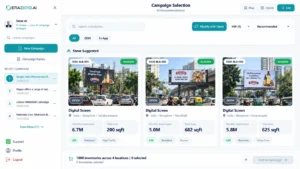
This is where the difference between a generic AI marketing assistant and a campaign launch AI platform becomes clearer.
After building the campaign brief, the workflow doesn’t stop at recommendations like:
“You should consider outdoor advertising.”
Steve can connect the campaign to available advertising inventory.
The Campaign Selection screen displays recommended inventory options that match the campaign.
Marketers can browse the recommendations using:
- Map view
- Hybrid view
- List view
Inventory can also be filtered by relevant media categories.
Each inventory card can show useful planning information such as:
Location
Media type
Availability
Monthly impressions
Advertising area
Inventory characteristics
Instead of a startup team manually collecting inventory PDFs and spreadsheets from several media owners, the planning process becomes much more centralized.
That can save a lot of time.
But more importantly, it makes the decision easier to understand.
5. Choose Media Based on the Campaign, Not Just What a Vendor Sends
This is an important distinction.
Traditional media buying can easily become inventory-led.
A vendor sends ten billboard options.
The startup chooses two.
The campaign is now based largely on what happened to be offered.
EraZero’s Steve AI workflow starts the other way around:
Objective → Audience → Location → Budget → Media → Inventory
That changes how a startup approaches advertising.
Instead of asking:
“Which billboard should we buy?”
The team can ask:
“Which available placements best support the campaign we’re trying to run?”
That’s a healthier media-planning process.
For growth teams using startup marketing AI, the AI isn’t just producing copy or audience personas.
It’s helping connect strategy to actual media decisions.
6. Review the Full Campaign Before Moving Ahead
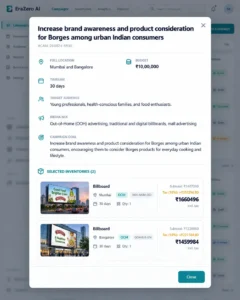
Before moving forward, the campaign details can be reviewed in one place.
The campaign view brings together information such as:
Full location
Where the campaign will run.
Budget
The planned campaign spend.
Timeline
How long the campaign will run.
Target audience
Who the campaign is designed to reach.
Media mix
Which advertising channels are included.
Campaign goal
The business objective behind the campaign.
Selected inventories
The actual advertising placements being considered or booked.
Pricing information for selected inventory can also be shown, giving the team better visibility into how the campaign budget is being used.
For a founder or growth lead, this makes approval much easier.
You don’t need to reconstruct the plan from several spreadsheets before asking:
“Are we comfortable launching this?”
The essential campaign information is already together.
Why This Works Particularly Well for Startup Teams
The real advantage isn’t simply that Steve AI is “AI-powered.”
The value is that it compresses a workflow that normally needs several people.
A founder can start with the business objective
You don’t need to know media terminology before beginning.
Explain what the business needs.
Steve helps structure the rest.
A marketer doesn’t need to manually build every part of the brief
Audience, geography, objectives and media planning become part of the same guided conversation.
Growth teams can move faster
Instead of spending days going back and forth just to prepare an initial media plan, teams can move from an idea toward inventory exploration in a connected workflow.
Media choices become easier to compare
Inventory recommendations can be reviewed alongside practical information such as location, availability and estimated impressions.
The startup still stays in control
Steve suggests and structures.
The team still decides.
You can review the campaign, modify it, select inventory and check the final campaign details before moving ahead.
That’s an important distinction.
Good AI advertising for startups shouldn’t remove decision-making from the founder.
It should remove unnecessary complexity around the decision.
Steve AI Is Most Useful When You Give It a Better Brief
AI can help organize a campaign, but the quality of the initial thinking still matters.
A prompt like:
“Advertise my startup.”
doesn’t give much strategic context.
A much better starting brief would be:
“We’re launching a premium healthy-snacking brand in Bengaluru and Mumbai. We want to build awareness among 25–40-year-old working professionals and health-conscious families. We have a ₹10 lakh media budget and want a 30-day brand campaign.”
Now Steve has something useful to work with.
Before opening the platform, startups should ideally know five things:
- What are you promoting?
- What do you want the campaign to achieve?
- Who should see it?
- Where are those people?
- How much are you prepared to spend?
You don’t need the entire media plan.
That’s what the planning workflow is there to help build.
What Steve AI Helps With — and What the Startup Should Still Own
| Steve AI can help structure | Startup team should decide |
| Campaign objectives | Business priorities |
| Audience definition | Who the best customer really is |
| Geographic planning | Which markets matter commercially |
| Media recommendations | Final channel strategy |
| Inventory discovery | Which placements to approve |
| Campaign summaries | Final budget approval |
| Campaign organization | Creative and brand direction |
The best use of AI is collaboration.
Not autopilot.
Start With the Campaign Idea. Let Steve Help Build the Plan.
A startup doesn’t necessarily need a ten-person advertising department to think professionally about media.
It needs a clear objective.
A defined customer.
A realistic budget.
And a planning process that connects those things to actual advertising opportunities.
That’s what makes startup marketing AI useful when it’s built into the campaign workflow rather than sitting outside it as a standalone chatbot.
With Steve AI inside EraZero, a founder or marketer can move from:
“We need to advertise.”
to:
Campaign objective → audience → cities → budget → media mix → recommended inventory → campaign review.
All without starting from a complicated media spreadsheet.
For lean startup teams, that can mean spending less time trying to figure out how to build the campaign and more time deciding what kind of campaign will actually move the business forward.
Start with Steve AI. Describe the campaign you want to run, refine the brief, explore recommended media inventory and build your campaign from one connected workflow.