Most transit advertising is easy to ignore.
A logo on a cab door.
A product shot on the back of a bus.
A phone number on an auto.
Technically, they’re ads. But they rarely become something people remember.
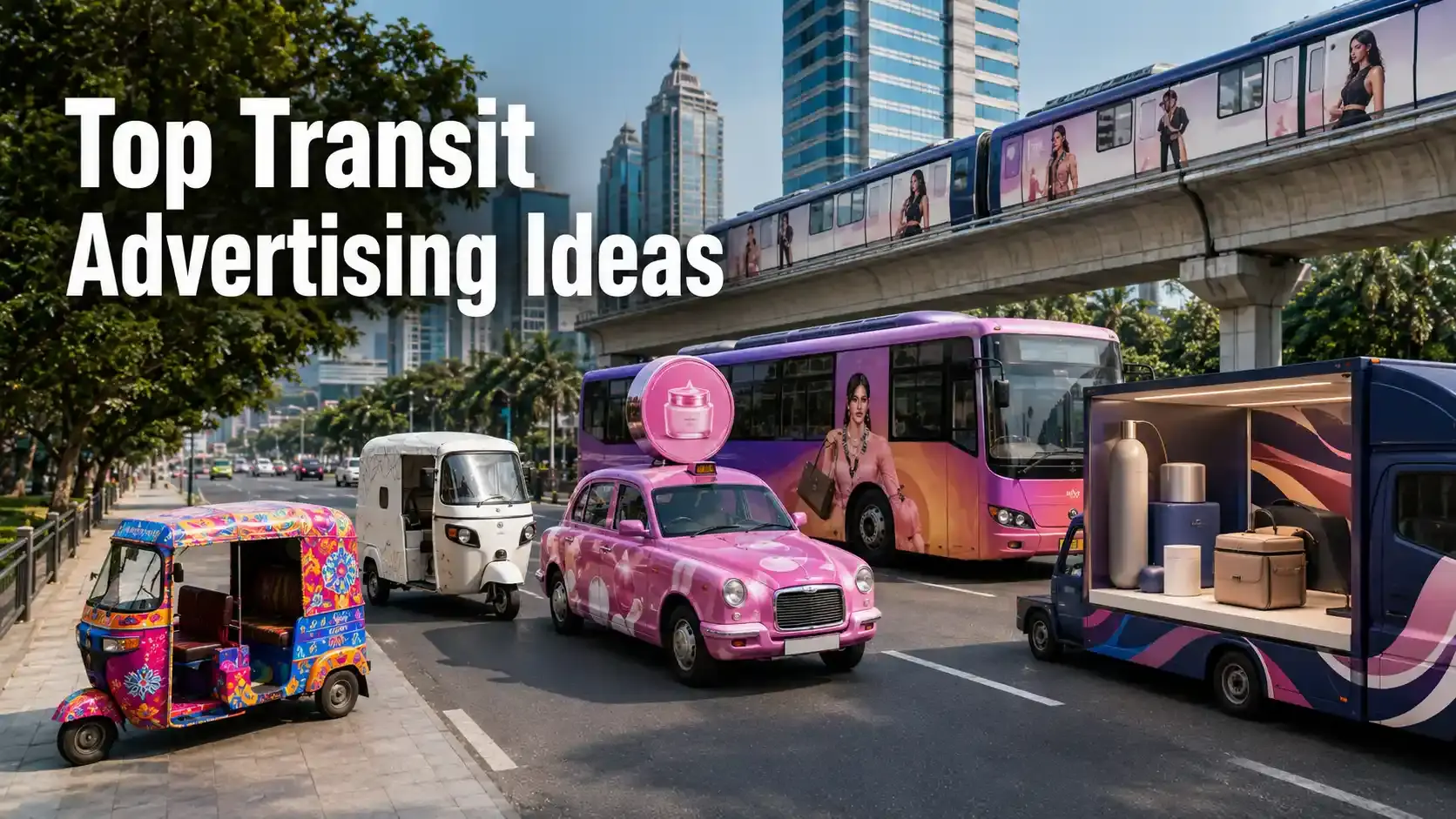
The most interesting transit advertising ideas do something else entirely.
They use the shape of the vehicle, the route it follows, the people around it and sometimes even the inside of the vehicle to create something that wouldn’t work on a normal billboard.
A cab can carry a giant product.
An auto can become an immersive brand space.
A truck can turn into an enormous plate of food.
A bus can become a moving bedroom.
And a metro train can become one long product story.
For brand managers across FMCG, D2C, fintech, retail and other consumer categories, these are the transit campaigns worth learning from.
1. Consumer Tech: Nothing Mobile Turns an Auto Into the Brand Experience
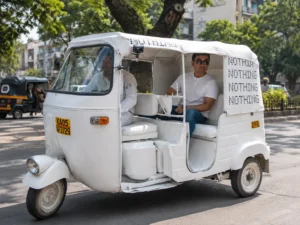
Nothing Mobile’s auto branding stands out because it doesn’t feel like a regular vehicle wrap.
Instead of simply placing the logo on the outside, the entire auto has been transformed around Nothing’s distinctive minimal visual identity. The white exterior, matching seats, stripped-back interior and dot-style branding make the vehicle itself feel like an extension of the brand.
That matters for a technology brand like Nothing, where design is part of the product story.
Why this idea works
The campaign brings Nothing’s clean, unconventional aesthetic into the physical world.
People don’t just see a logo while the auto passes them. Passengers can actually sit inside a branded environment, making the experience far more memorable than a standard door-panel or rear-panel advertisement.
The execution works particularly well because it:
- carries Nothing’s recognizable minimalist design language into transit media;
- turns an everyday auto-rickshaw into something unexpected;
- creates strong street-level curiosity;
- gives passengers a closer, more immersive interaction with the brand;
- naturally creates a visually distinctive moment people may want to photograph or share.
What other tech and D2C brands can learn
Consumer-tech brands don’t always need to show a huge product image.
Sometimes translating the brand identity into the vehicle itself can be much stronger.
A smartphone brand could build the auto around its UI design language. A wearable brand could create an interior inspired by its health or fitness ecosystem. A fintech brand could use a similar format to create a fully cashless, QR-enabled commute experience.
The lesson from Nothing is simple:
Don’t just advertise the technology. Make the transit experience feel like the brand.
2. Lifestyle & Gifting: Make Full-Wrap Autos Impossible to Miss
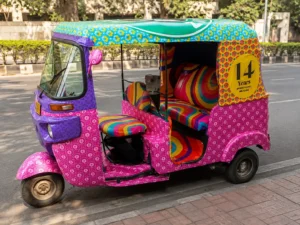
For a brand like Kottanz, a full-wrap auto works beautifully because the vehicle itself can reflect the brand’s handcrafted, joyful and design-led personality.
Kottanz is all about handmade eco-luxury gifts, gifting collections and occasion-based products, so a plain logo placement would feel too ordinary. A colourful full-wrap auto, on the other hand, can carry the same richness, warmth and visual charm that people associate with gifting, celebration and handcrafted design.
Why this idea works
Autos naturally move through exactly the kinds of places where Kottanz can attract attention:
- residential neighbourhoods;
- premium local shopping streets;
- festive markets;
- wedding and event zones;
- gifting-heavy retail areas;
- high-footfall lifestyle hubs.
A vibrant auto like this doesn’t feel like just another transit ad. It feels like a moving expression of the brand.
That matters for Kottanz because the brand sells emotion as much as product. The campaign should instantly communicate celebration, creativity and thoughtful gifting.
Make the fleet feel like a gifting collection
One of the most interesting ways Kottanz could scale this format is by giving different autos different themes based on gifting occasions or collections.
For example:
- Wedding gifting = rich festive colours and premium handcrafted styling
- Housewarming gifts = earthy, elegant décor-inspired branding
- Baby shower gifting = playful, soft and cheerful visuals
- Festival gifting = vibrant celebratory designs
- Corporate gifting = cleaner premium styling with sophisticated detailing
Each auto becomes its own branded theme, while the fleet together feels like a moving Kottanz collection.
Why this fits Kottanz so well
Kottanz already spans gifting categories such as:
- hampers;
- return gifts;
- corporate gifting;
- housewarming;
- wedding;
- baby shower;
- festive collections;
- décor and handcrafted accessories.
That gives the brand a huge advantage in transit media. Instead of repeating one identical creative across every vehicle, Kottanz can turn each auto into a different part of its gifting universe.
The result is much more memorable.
One auto creates visibility. A themed fleet creates a travelling handcrafted brand experience.
3. D2C & Beauty: Put the Product on Top of the Cab
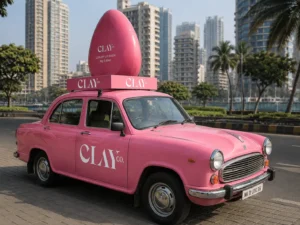
This is the kind of transit campaign people notice without needing to read much.
Instead of printing the product on the vehicle, the campaign turns the product into a physical object mounted above it.
That changes everything.
The product Clay Co becomes the silhouette of the media.
Why 3D cab branding works
It is especially strong when the product has a distinctive shape:
- perfume;
- skincare;
- cosmetics;
- beverage bottles;
- food packs;
- headphones;
- footwear.
For a D2C brand launching a hero product, this can create much more attention than using ten different messages across the vehicle.
The creative principle should be:
One product. One bold visual. One thing people remember.
For fintech, a similar technique could use an oversized physical debit or credit card — but only when it supports a strong campaign idea rather than feeling like decoration.
4. Home & Lifestyle: Turn the Bus Into the Product Environment
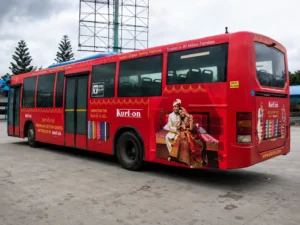
What makes this execution interesting is that it doesn’t simply say:
“We sell mattresses.”
The bus visually becomes part of the bedroom experience.
That’s an important lesson for large-format transit advertising.
The bigger the vehicle, the more opportunity there is to demonstrate the product rather than simply display it.
Ideas brands could adapt
A cookware company could turn a bus into a moving kitchen.
A fitness brand could visually turn one into a gym.
A home interiors brand could create different rooms across different sections.
A fashion brand could build a giant wardrobe concept.
For D2C companies like Kurlon, this can be particularly useful because a physical bus gives an online-first brand a scale and presence it normally doesn’t have.
5. Food & FMCG: Make the Truck Look Like the Product
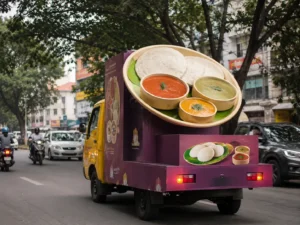
This is one of the strongest examples in the set in Hotel Industry Babai Hotel .
The campaign doesn’t rely on a long headline.
You see the truck and immediately understand the category.
The oversized idli installation turns an ordinary commercial vehicle into something closer to street theatre.
That’s exactly why it works.
The opportunity for FMCG brands
Imagine:
- a giant biscuit packet opening out of a truck;
- oversized chips spilling from the back;
- a beverage bottle built into the truck body;
- a chocolate bar appearing to break through the roof;
- a giant ice cream cup travelling through the city.
Food is already highly visual.
Transit gives brands the chance to make it larger than life.
For product launches, this kind of truck branding can be especially effective around:
- retail areas;
- launch markets;
- food districts;
- malls;
- events;
- college areas.
The best truck campaigns don’t look like branded logistics.
They look like the product has entered the street.
6. Retail & D2C: Create a Store That Moves
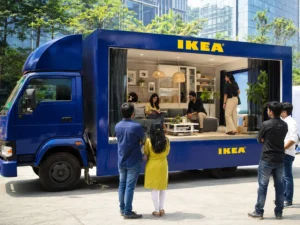
This is where transit advertising starts to blur into experiential marketing.
Ikea Instead of simply telling people what the brand sells, the truck physically shows the product environment.
For a furniture brand, the format makes perfect sense.
You can actually see how the products look together in a room.
This idea can go far beyond furniture
A beauty brand could create a mobile beauty studio.
A consumer electronics brand could create a product-demo truck.
A D2C mattress company could build a small sleep experience.
A coffee company could operate a miniature café.
A fintech company could even create a mobile financial education or product-demo experience around payments, investing or savings.
The vehicle becomes:
media + demonstration + experience.
And that is much harder to ignore than a normal ad panel.
7. Automotive, Fintech & Large Consumer Brands: Use the Whole Metro as a Story
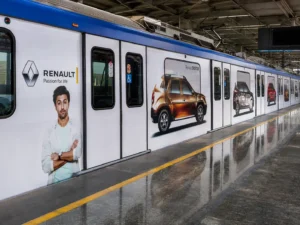
A metro train gives brands something unusual:
length.
Yet many campaigns waste that opportunity by repeating exactly the same artwork across every coach.
A better approach is to treat the train as a sequence.
For an automotive brand
Each coach could highlight:
- exterior design;
- interior;
- technology;
- safety;
- performance.
For a fintech brand
The entire train could tell one financial journey:
Spend → Save → Invest → Protect
For an FMCG brand
Each coach could feature a different flavour or product.
For a D2C brand
The train could move from:
Problem → Solution → Product → Proof → CTA
That makes the commute itself part of the storytelling.
A metro wrap shouldn’t simply be a giant poster.
It can be a moving campaign people experience coach by coach.
Which Transit Idea Fits Which Industry?
| Industry | Transit Idea |
| Fintech | Metro storytelling, branded commuter cabs, interactive autos |
| D2C | 3D cabs, experiential trucks, full-wrap buses |
| FMCG | Full-wrap auto fleets, giant-product trucks, 3D cabs |
| Food & Beverage | Product-shaped trucks, colourful auto fleets |
| Retail | Moving showrooms, hyperlocal autos and cabs |
| Home & Lifestyle | Experiential buses and mobile showrooms |
| Automotive | Full metro and train wraps |
The Vehicle Should Be Part of the Idea
The common thread across all these campaigns is surprisingly simple.
The brands didn’t ask:
“Where can we place our logo?”
They asked:
“What can we do because this media moves?”
That change in thinking creates a completely different kind of campaign.
An auto becomes an immersive experience.
A cab becomes an oversized product.
A bus becomes a room.
A truck becomes food.
Another truck becomes a store.
A metro becomes a story.
That’s where the best transit advertising ideas begin.
For brand managers, the creative idea should come first — followed by the right vehicle type, route, geography and audience.
With EraZero AI, brands can explore transit formats such as cab branding, auto advertising, bus branding, metro advertising and truck branding, and plan campaigns around the audiences and locations that actually matter.
Don’t just put your campaign on the road. Create something people notice because it’s on the road.