Publishing a high-quality mobile game no longer guarantees that players will discover it. App stores contain thousands of games competing for the same attention, while users can uninstall a game within minutes when the experience does not meet their expectations.
A successful mobile game advertising strategy must therefore do more than generate inexpensive downloads. It must attract suitable players, convert app store visitors, encourage users to complete onboarding and create enough value for them to keep playing.
The real objective is not to generate the highest possible number of installs. It is to acquire players who engage, return, recommend the game and eventually contribute to revenue.
Why Mobile Game Advertising Needs a New Approach
Traditional app-install campaigns were often measured mainly through impressions, clicks and cost per install. These metrics still matter, but they do not provide a complete picture of campaign performance.
A low-cost install may deliver limited value when the user opens the game once and never returns. A slightly more expensive install may be more valuable when the player completes onboarding, reaches multiple levels, watches rewarded ads or makes an in-app purchase.
Mobile game marketing in 2026 must therefore connect acquisition with post-install behaviour. Campaign decisions should be based on player quality, retention, lifetime value and return on ad spend—not downloads alone.
1. Define Your Ideal Player Before Selecting Channels
Before launching an app install campaign, create a detailed profile of the player you want to reach.
Consider:
- Preferred game genre
- Age group
- Device and operating system
- Language
- Location
- Playing habits
- Session duration
- Competitive or casual behaviour
- Likely monetisation preference
A casual puzzle game may appeal to players looking for short, relaxing sessions. A strategy or multiplayer game may require users interested in progression, competition, collaboration and longer gameplay.
The campaign objective must also be specific. It could be:
- Pre-registrations
- First-time installs
- Completed tutorials
- Level completion
- Day-one or day-seven retention
- In-app purchases
- Returning inactive players
Defining the player and the desired action helps prevent the advertising budget from being spent on audiences that may install the game but never become active users.
2. Strengthen App Store Optimization Before Buying Traffic
Paid media cannot compensate for a weak app store listing. Before increasing campaign spending, improve the game’s title, description, icon, screenshots, preview video, ratings and localisation.
The first few visual elements should immediately communicate:
- What type of game it is
- What the main gameplay mechanic looks like
- What makes the game different
- Whether it is single-player or multiplayer
- What kind of progression or rewards players can expect
Show real gameplay instead of relying entirely on generic character artwork or cinematic scenes that do not represent the experience.
Use relevant keywords naturally within the app store listing. Depending on the game, these may include phrases such as “multiplayer strategy game,” “offline racing game,” “casual puzzle game” or “mobile adventure game.”
App store optimization should support advertising, not operate separately from it. When an ad promises a particular challenge, character or gameplay experience, the app store page should continue the same message.
3. Build a Full Mobile Game Acquisition Funnel
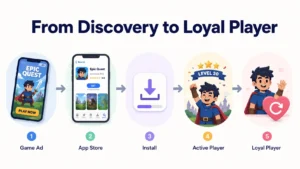
A strong mobile game user-acquisition strategy should cover more than the moment when someone clicks an advertisement.
A complete funnel may include:
Awareness: The user first discovers the game through a video, creator post, mobile advertisement or display placement.
Consideration: The user watches gameplay, reads reviews or visits the app store listing.
Install: The user downloads and opens the game.
Activation: The player completes the tutorial or first important level.
Retention: The player returns over the following days.
Monetisation: The user makes a purchase, subscribes, watches rewarded ads or participates in paid events.
Planning around the full journey helps studios identify where users are dropping off. A campaign may generate strong click-through rates but weak app store conversion. Another campaign may generate installs but lose players during onboarding.
Each stage requires a different improvement strategy.
4. Create a Multi-Channel App Install Strategy
Do not depend entirely on one social media platform or one advertising format. Combine search campaigns, short-form video, creator-led content, display placements, app discovery campaigns and in-app advertising.
In-app advertising can help game publishers reach mobile users while they are already active inside entertainment, ecommerce, sports, news, utility, lifestyle and other app environments.
The most appropriate placement depends on the game genre and player profile. A sports game may benefit from audiences consuming sports content, while a casual game may find broader opportunities across entertainment, utility and lifestyle apps.
An effective multi-channel advertising strategy gives each channel a specific role. Video can demonstrate gameplay, search can capture active interest, creator content can build credibility and in-app placements can generate scalable mobile reach.
5. Turn Gameplay Into the Advertisement
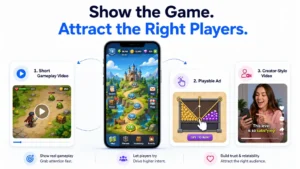
The strongest mobile gaming ads help users understand the experience quickly.
Instead of starting with a long introduction, show the central gameplay loop within the opening seconds. A player should immediately understand what they will do after installing the game.
Possible creative hooks include:
- A difficult level or challenge
- A character upgrade
- A competitive battle
- An unexpected failure
- A reward or unlock
- A transformation sequence
- A limited-time event
- A surprising game mechanic
Playable ads can be particularly useful because they allow users to try a simplified version of the game before downloading it. This can improve the quality of acquired players because users understand the basic experience before installing.
The advertisement must still represent the real game. Misleading gameplay may produce curiosity-driven clicks, but it can also lead to poor reviews, rapid uninstalls and low player trust.
6. Test Multiple Creative Directions
Creative fatigue can quickly reduce the performance of mobile gaming ads. Repeatedly showing the same video, character or message to an audience can cause engagement to decline.
Develop multiple variations based on:
- Opening hook
- Gameplay sequence
- Character
- Difficulty level
- Reward
- Headline
- Call to action
- Video duration
- Visual style
- Local language
Do not change every element simultaneously. Test one major variable at a time so that the team can identify what caused the performance difference.
An AI creative engine can help marketing teams explore more concepts, produce first drafts and adapt one campaign idea into different formats. Human review is still essential for game accuracy, brand consistency and final quality.
7. Match App Placements with Player Intent
Not every app environment serves the same purpose.
Entertainment and streaming environments can support video storytelling and game awareness. Sports and news apps can help publishers reach interest-based audiences. Ecommerce and food-delivery environments may offer high user activity but require a strong contextual reason for the game advertisement to appear.
The placement should be selected according to the campaign objective, audience behaviour, geography and game category.
EraZero’s guide to choosing between shopping, food-delivery and OTT app advertising explains how different mobile environments support different stages of the advertising funnel.
The same principle applies to mobile game promotion: do not choose an app only because it has a large audience. Select it because its users, content and usage context align with the type of player the game needs.
8. Measure What Happens After the Install
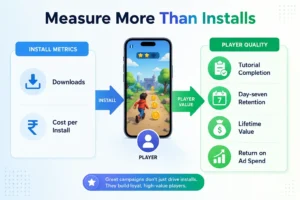
Cost per install is useful, but it should not be the final success metric.
Track:
- App store conversion rate
- Cost per first open
- Cost per completed tutorial
- Day-one retention
- Day-seven retention
- Cost per active player
- Cost per paying player
- Average session duration
- Player lifetime value
- Return on ad spend
Compare these metrics by channel, placement, campaign, creative, device, geography and audience segment.
A creative that produces inexpensive installs may perform poorly when measured against retention. Another creative may appear more expensive initially but attract users who remain active for longer.
This analysis helps studios reduce wasted ad spend by moving budgets away from placements that generate low-quality users and towards campaigns that create long-term player value.
9. Improve the First-Time Player Experience
Advertising performance does not end when the user installs the game.
A complicated tutorial, slow loading time, early technical issue or aggressive monetisation prompt can cause players to leave before experiencing the game’s real value.
Review the first session carefully. The player should quickly understand:
- What the objective is
- How the controls work
- What progress looks like
- What reward comes next
- Why they should return
The advertising promise and the onboarding experience must match. When the ad promotes a fast challenge, the player should not face a long introduction before reaching it.
Marketing and product teams should therefore evaluate acquisition and onboarding together.
10. Retarget and Re-Engage Existing Players
Many users install a mobile game, play briefly and then become inactive. Re-engagement campaigns can encourage them to return.
Create audience groups based on behaviour, such as:
- Installed but did not complete onboarding
- Completed the tutorial but did not return
- Reached a particular level and stopped
- Previously active but inactive for several days
- Participated in an earlier event
- Viewed a purchase offer but did not convert
Use messages connected to their progress. Promote a new level, character, reward, multiplayer event, seasonal update or limited-time challenge.
Deep links should take players directly to the most relevant part of the game rather than sending everyone to the general home screen.
11. Localise Mobile Game Campaigns for India
India should not be treated as one uniform gaming audience.
Player behaviour can differ by city, language, device type, internet quality and preferred game category. Create campaign variations that reflect these differences.
Test:
- Regional-language videos
- Local cultural references
- Festival-based events
- City- or state-level targeting
- Lightweight video formats
- Lower-data creative versions
- Device-specific messaging
- Different payment or reward propositions
Localisation should extend beyond translation. The creative should feel relevant to the audience’s entertainment preferences, humour, social behaviour and playing environment.
12. Scale Budgets Based on Player Quality
Do not scale a mobile game campaign only because it is generating cheap installs.
Start with controlled audience and creative tests. Identify which combinations deliver the best balance between acquisition cost, onboarding completion, retention and lifetime value.
Increase spending gradually on proven combinations. Continue testing new audiences and creatives while protecting the budget allocated to reliable performers.
An effective AI media-planning approach can help teams compare channels, audience groups, creative requirements and campaign objectives more systematically.
Grow Mobile Game Campaigns with EraZero AI
EraZero brings AI-assisted media planning, creative generation, media discovery and multi-channel advertising into one platform.
Game publishers can use Steve AI to structure campaign requirements around audience, location, budget and advertising objectives. Sara AI can support creative ideation and help develop campaign visuals for different formats.
Publishers can also explore in-app advertising opportunities across multiple mobile environments rather than coordinating every placement independently.
The objective is not simply to purchase more installs. It is to build a connected mobile game marketing system that attracts the right players, improves activation, increases retention and creates sustainable long-term growth.