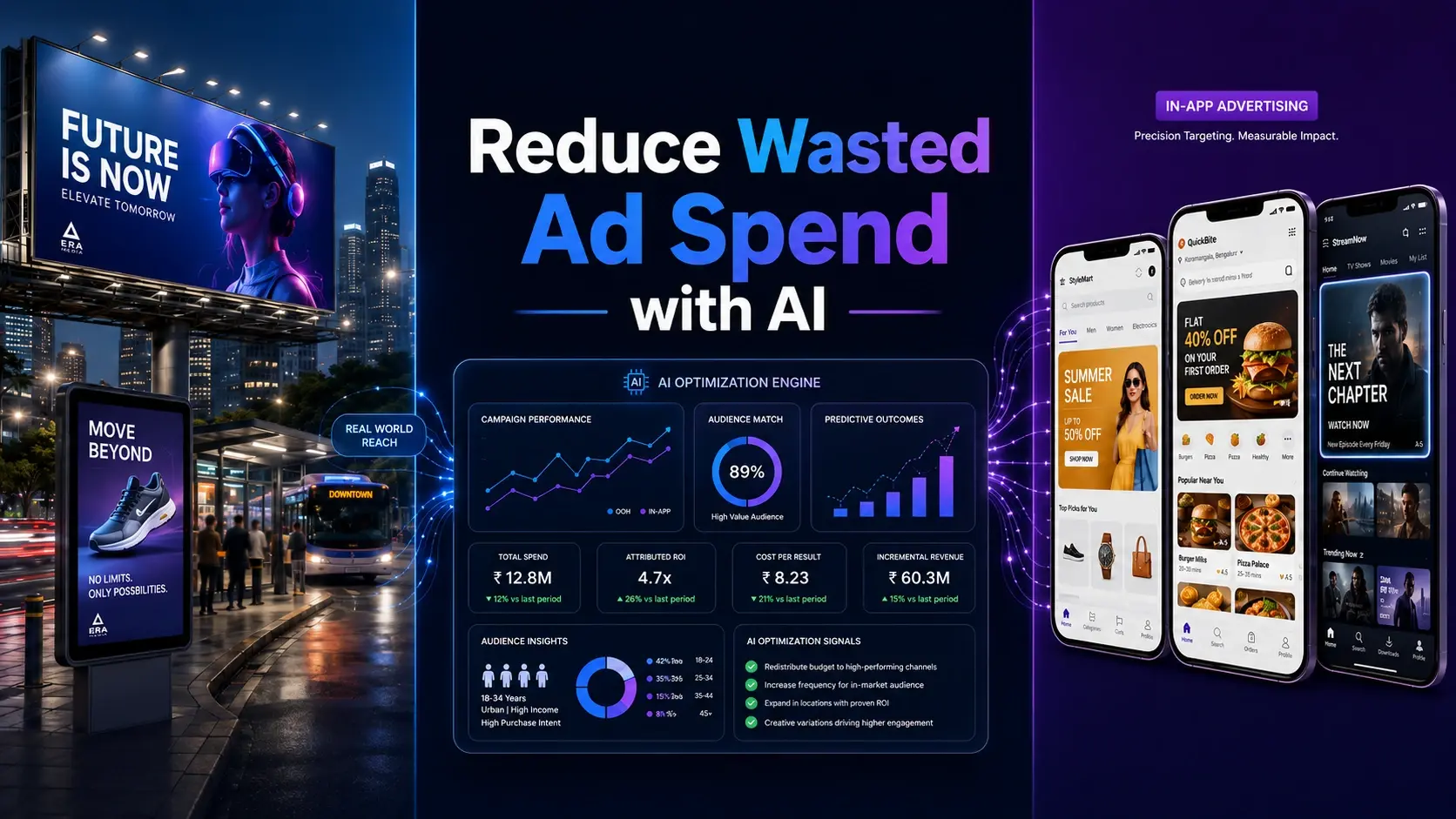
How AI Can Reduce Wasted Ad Spend in OOH and In-App Campaigns
For CMOs, CFOs, and performance marketers, one of the biggest advertising challenges is not spending money. It is spending money in the right place, at the right time, for the right audience. Every campaign has some level of waste, but when brands run large-scale OOH and in-app campaigns manually, wasted ad spend can increase quickly.
Budgets may go into low-performing locations, broad audiences, weak time slots, repeated impressions, or platforms that do not match the campaign goal. This is where AI ad optimization can create a measurable advantage.
AI helps brands reduce ad spend waste by using data, prediction, automation, and performance signals to improve media planning and campaign decisions. Instead of relying only on assumptions, brands can use AI to make every rupee work harder.
Why Wasted Ad Spend Happens
Wasted ad spend usually happens when media decisions are not aligned with audience behavior, location relevance, campaign timing, or business outcomes.
In OOH campaigns, waste can happen when brands select hoardings, billboards, transit media, cinema screens, or retail media without understanding audience movement, traffic quality, nearby points of interest, or campaign objective. A premium billboard may look attractive, but if the audience does not match the target segment, the ROI may be weak.
In in-app campaigns, waste can happen when ads are shown to broad users without proper category matching. For example, a food brand may perform better on food delivery and quick commerce apps, while a fashion brand may need shopping apps and entertainment platforms. If the app category does not match the audience intent, impressions may not convert.
How AI Improves Advertising ROI
AI improves advertising ROI by making media planning more precise. It can analyze large sets of data faster than a human planner, identify patterns, compare options, and recommend placements that are more likely to deliver results.
For a CMO, this means better campaign impact. For a CFO, it means stronger budget control. For performance marketers, it means improved targeting, tracking, and optimization.
AI ad optimization can help with:
- Audience targeting
- Location intelligence
- Budget allocation
- Campaign forecasting
- Creative recommendations
- Performance tracking
- Cross-channel media planning
The goal is simple: reduce ad spend waste and improve advertising ROI.
AI in OOH Campaigns: Smarter Location Selection
OOH advertising is powerful because it reaches people in the real world. But not every outdoor location is equally valuable for every brand. AI can help advertisers compare media options based on audience density, location type, traffic patterns, nearby commercial areas, city zones, and estimated visibility.
For example, a luxury automobile brand may need premium business districts, airport routes, and high-income neighbourhoods. A quick commerce brand may need residential clusters, office areas, and high-density urban zones. A retail brand may need media near malls, high streets, and shopping zones.
AI helps brands move from “this location looks good” to “this location matches the campaign goal.”
This reduces waste by avoiding low-relevance placements and prioritizing OOH inventory that has a stronger chance of influencing the right audience.
AI in In-App Campaigns: Better Audience and Platform Matching
In-app advertising works best when the app environment matches the user’s intent. Shopping apps, food delivery apps, OTT platforms, fintech apps, travel apps, and music streaming apps all serve different audience moments.
AI can help brands choose the right app categories based on campaign objective. If the goal is conversion, ecommerce and quick commerce apps may be more relevant. If the goal is awareness, OTT and entertainment apps may perform better. If the goal is impulse engagement, food delivery apps can be useful.
For example, an FMCG brand may combine Swiggy, Zomato, Zepto, BigBasket, and Blinkit for consumption-led targeting. An ecommerce brand may use Flipkart, AJIO, Meesho, and OTT platforms for both product discovery and reach. A financial services brand may use fintech and utility apps to reach users in a relevant decision-making mindset.
AI reduces wasted spend by matching the brand objective with the right in-app environment.
Real-Time Optimization and Budget Control
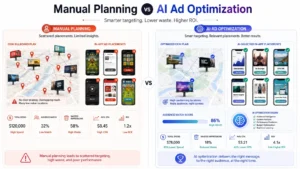
Traditional media planning often locks budgets too early. Once money is allocated across platforms or locations, it can be difficult to adjust quickly. AI changes this by helping advertisers monitor signals and make smarter decisions during the campaign.
In digital and in-app campaigns, AI can identify which audiences, creatives, formats, or app categories are performing better. In OOH and DOOH campaigns, AI can support better planning through location data, performance estimates, and campaign reporting.
This matters for CFOs because campaign efficiency is not only about total spend. It is about how much of that spend contributes to measurable business outcomes.
AI can help brands reduce underperforming placements, shift budgets toward better-performing channels, and improve the overall media mix.
Creative Optimization: Reducing Waste from Weak Messaging
Even the best media placement can fail if the creative is not relevant. AI can support creative planning by suggesting campaign messages, formats, audience-specific variations, and platform-friendly content.
For OOH, AI can help brands create simple, high-impact creatives that work for short viewing windows. For in-app ads, AI can suggest different messaging for shopping, food delivery, OTT, and utility app audiences.
A performance marketer can test multiple creative directions instead of relying on one message. This reduces wasted impressions and improves the chance of engagement.
How EraZero Helps Reduce Ad Spend Waste
EraZero AI is built to simplify advertising across multiple media channels through AI-powered planning. The platform supports services across OOH, in-app advertising, cinema, drone show advertising, quick commerce, retail, radio, print, and television advertising.
For brands running OOH and in-app campaigns, EraZero AI helps bring media discovery, planning, comparison, and execution into a more structured workflow. Instead of manually comparing scattered media options, teams can use an intelligent planning approach to evaluate inventory, audience fit, campaign goals, and media formats.
This is especially useful for CMOs who want strategic reach, CFOs who want budget accountability, and performance marketers who want measurable campaign results.
AI Ad Optimization
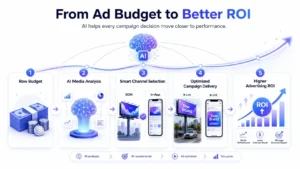
AI does not replace strategy. It improves it. Brands still need strong positioning, clear goals, and good creative. But AI helps reduce the guesswork that often leads to wasted ad spend.
For OOH campaigns, AI improves location and inventory selection. For in-app campaigns, it improves audience, app category, and format matching. Across both channels, AI helps marketers optimize budgets, reduce inefficiency, and improve advertising ROI.
As advertising becomes more fragmented, brands that use AI ad optimization will have a clear advantage. They will not just spend more. They will spend smarter.