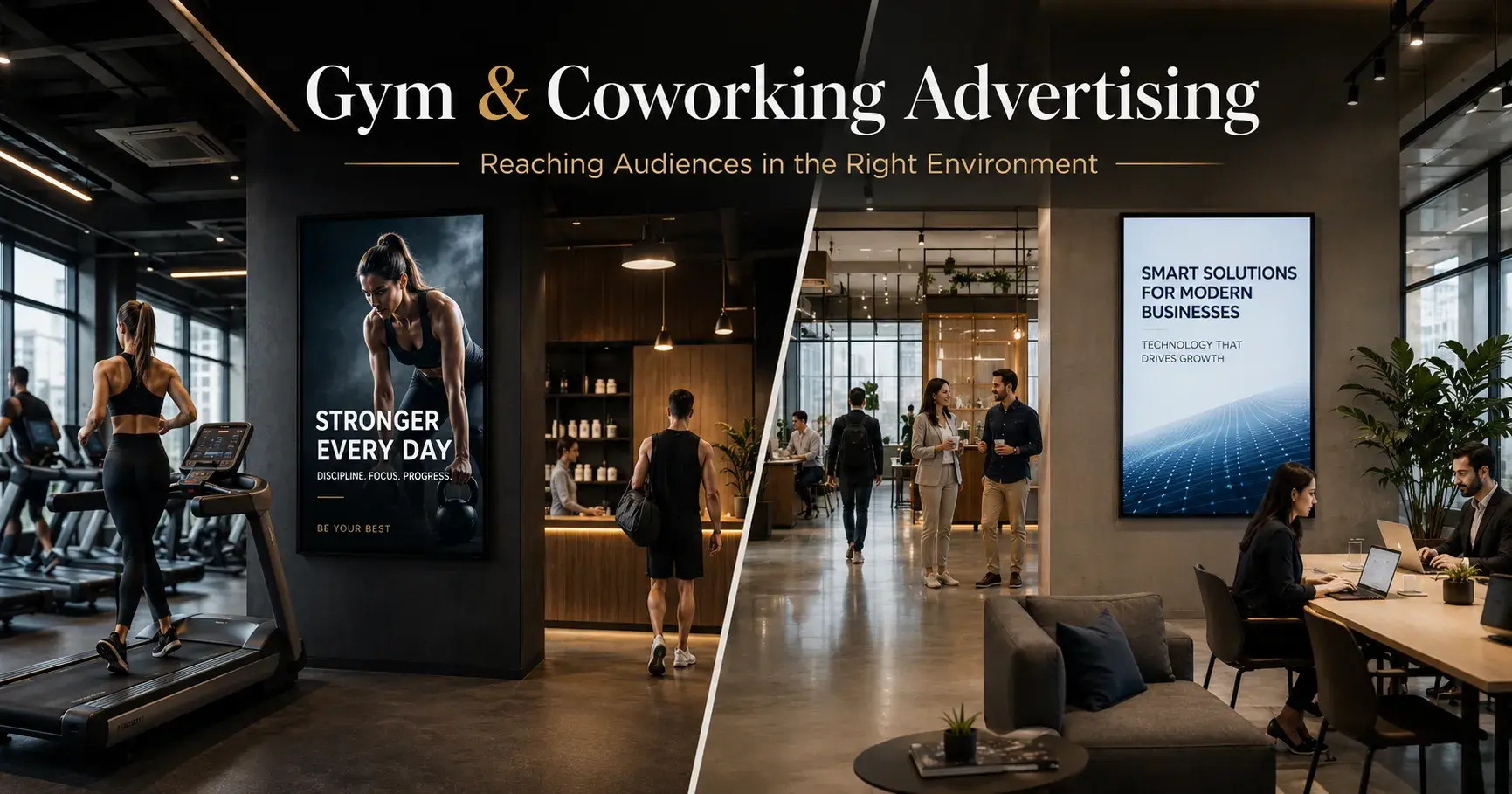
Advertising works differently when the environment already tells you something about the audience.
A digital screen inside a gym reaches someone while fitness, wellness and personal goals are already on their mind. A screen inside a coworking space reaches someone during their workday, surrounded by meetings, technology, business conversations and professional decision-making.
That’s why gym advertising and coworking space advertising are becoming interesting extensions of modern Digital Out-of-Home strategies.
These environments belong to a broader category known as place-based media, where advertising appears in locations chosen not simply for footfall, but for the kind of people who regularly spend time there.
For brands trying to reach active urban consumers, professionals, founders, employees or technology-focused audiences, gyms and coworking spaces create a more contextual advertising opportunity than a generic indoor screen.
Why Place-Based Media Works Differently
Traditional outdoor advertising usually begins with geography. A brand selects a road, junction, shopping district or transit corridor based on traffic and audience movement.
Place-based advertising adds another layer: the environment itself.
Someone entering a gym has chosen to spend time in a fitness environment. Someone working from a coworking centre has entered a professional ecosystem. Those choices provide useful context for advertisers.
That doesn’t mean every person inside a gym has identical interests or every coworking member is a business decision-maker. It means the venue gives the campaign a stronger starting point.
This is particularly important for indoor digital screens because digital creative can be adapted to different locations, audiences, campaign periods and sometimes even times of day.
The same brand can therefore communicate differently in a gym, corporate lobby, mall or coworking centre without changing its overall campaign objective.
Gym Advertising Creates a Fitness and Lifestyle Context
The value of gym advertising is not simply that people spend time exercising. It is that fitness centres create repeated exposure among audiences who often return several times a week.
Digital screens can appear near reception areas, workout floors, cardio sections, studios, cafés and other common areas. Static branding, sampling and activations can also be layered around the same environment.
The strongest campaigns use that setting instead of ignoring it.
A sportswear brand can naturally connect its message to movement and performance. A smartwatch campaign can speak about tracking workouts. A healthy beverage can position itself around hydration or recovery. A healthcare or wellness service can communicate preventive care in an environment where health is already part of the conversation.
This is where gym advertising becomes more useful than simply placing a generic brand creative on a screen.
The message fits the moment.
Fitness-related categories are obvious candidates, but the opportunity extends further. Consumer technology, travel, premium financial products, grooming, automotive and food-delivery brands may also fit selected gym environments depending on the member profile and location.
A premium fitness club in a technology district, for example, may attract a very different audience from a neighbourhood gym. Media planning should account for that difference.
Coworking Space Advertising Reaches People During the Workday
The context changes when the campaign moves into a coworking environment.
Coworking space advertising reaches people while work, productivity and professional activity are already happening around them.
Modern coworking spaces are no longer used only by freelancers and early-stage startups. They can include technology teams, consultants, sales organisations, growing companies, remote employees, founders and larger corporate teams using flexible offices.
That gives advertisers access to a potentially valuable professional audience.
Digital screens may appear in reception areas, lift lobbies, cafeterias, common corridors, break-out spaces and meeting zones. Brands can also use on-ground experiences such as demonstrations, events or registration kiosks when the campaign needs deeper engagement.
The strongest categories are naturally different from those in gyms.
SaaS, fintech, banking, telecom, professional education, recruitment, enterprise technology and business travel can all fit the workplace environment well.
Consumer brands can also belong there. Smartphones, laptops, coffee, food delivery, premium cards and mobility services are all connected to everyday working life.
The key is relevance.
A productivity software advertisement inside a coworking café immediately makes sense because the audience is already thinking about work. The same creative shown in an unrelated environment may need much more explanation.
Indoor Digital Screens Give Brands Creative Flexibility
One reason indoor digital screens work well in gyms and coworking spaces is that they allow campaigns to be changed more easily than traditional printed indoor media.
A campaign might use static visual creatives, motion graphics, short-form video or QR-enabled calls to action. Different creatives can also be designed for different venue types.
This matters because a brand should rarely use exactly the same advertisement everywhere.
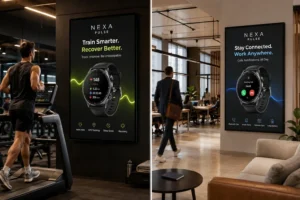
Imagine a wearable technology company launching a new smartwatch.
Inside a gym, the message could focus on workouts, heart rate and recovery.
Inside a coworking space, the same product could focus on productivity, notifications, calls and staying connected during the workday.
The product is identical.
The advertising becomes stronger because the context changes.
That is one of the most important advantages of place-based media.
The Best Creative Feels Native to the Environment
Brands often treat indoor media as a smaller version of outdoor media.
That can lead to crowded layouts, generic messaging and creatives that feel disconnected from the venue.
A stronger approach starts with one question:
What is this person likely doing when they see the screen?
A gym viewer may be walking toward a workout, resting between sessions or leaving after exercising.
A coworking viewer may be arriving for work, waiting for a lift, taking a coffee break or moving between meetings.
The creative should respect that situation.
Headlines should be short. Product visibility should be strong. The core benefit should be understood quickly. If the campaign includes a QR code or digital response mechanism, there should be one obvious reason to scan.
Context-specific copy can make the difference between a screen being noticed and becoming visual background.
Gym and Coworking Advertising Can Support Different Brand Goals
Although both channels use indoor environments, they solve different audience challenges.
Gym advertising is naturally aligned with fitness, wellness, lifestyle and personal-consumption moments. It can work especially well for brands that want repeated exposure among active consumers.
Coworking space advertising is more closely associated with professional behaviour, workplace technology, career development and business activity.
Some categories can use both.
A premium credit card might communicate travel rewards to professionals in coworking spaces and lifestyle privileges to gym members. A smartphone brand could talk about productivity in the workplace and health tracking in fitness environments.
Rather than seeing gyms and coworking spaces as competing channels, brands can treat them as different audience moments within the same urban journey.
Place-Based Advertising Works Best as Part of a Wider Media Plan
Gyms and coworking spaces do not have to operate as isolated media environments.
A consumer might see a brand on a large roadside digital screen in the morning, encounter it again inside a corporate or coworking lobby during the day, and see a third message at the gym in the evening.
Each placement can reinforce the same campaign from a different angle.
That makes place-based media particularly useful within broader DOOH and omnichannel strategies.
Brands can combine indoor environments with outdoor screens, mall media, corporate parks, in-app advertising, social campaigns or mobile retargeting.
EraZero’s Digital OOH advertising capabilities are designed around this broader approach, helping advertisers discover relevant digital media environments based on audience, geography and campaign objectives rather than treating every screen as an isolated placement.
Choosing the Right Gym or Coworking Environment
The quality of a campaign depends heavily on venue selection.
Brands should look beyond broad labels such as “premium gym” or “coworking network” and understand the actual environment.
Location, audience profile, screen placement, visibility, venue usage and surrounding business district can all influence whether the placement makes sense.
A B2B software company may prioritise coworking locations inside major technology and corporate districts. A wellness brand may choose fitness centres where the member profile closely matches its customer.
The goal is not to appear in the maximum number of locations.
It is to select environments where the audience, context and message naturally fit together.
Reaching Audiences When the Environment Adds Meaning
The real opportunity with gym advertising, coworking space advertising and other forms of place-based DOOH is not simply access to another set of screens.
It is access to specific audience moments.
Gyms create a fitness and lifestyle environment.
Coworking spaces create a professional and productivity-focused environment.
When brands understand those differences, digital screens can become more than just display inventory. They become contextual touchpoints within the customer’s day.
That is the strength of place-based media: the location doesn’t merely carry the advertisement.
It helps give the advertisement meaning.