Marketing teams have more technology than ever.
They have analytics dashboards, media-buying tools, creative software, audience platforms, spreadsheets, agency reports and separate systems for digital, outdoor and offline media.
Yet launching a campaign can still involve dozens of emails, multiple vendors and hours of manual planning.
That gap is where the BrandTech AI platform is emerging.
BrandTech isn’t simply another tool for generating ad copy. At its most useful, it connects brand strategy, audience intelligence, media planning, creative development, inventory discovery, campaign execution and measurement through one technology layer.
For enterprise brands, agencies and marketing leaders, the real question isn’t whether AI can generate an advertisement.
It’s whether AI can help manage the increasingly complicated system behind advertising.
What Is a BrandTech AI Platform?
“BrandTech” isn’t as universally standardized a category as MarTech or AdTech. A practical way to understand it is as technology built around the needs of the brand and its complete advertising workflow, rather than one isolated advertising function.
A traditional tool might solve one task:
- generate creatives;
- buy programmatic media;
- analyze audiences;
- manage PPC;
- track campaign performance.
A BrandTech AI platform aims to connect several of these decisions.
The workflow becomes:
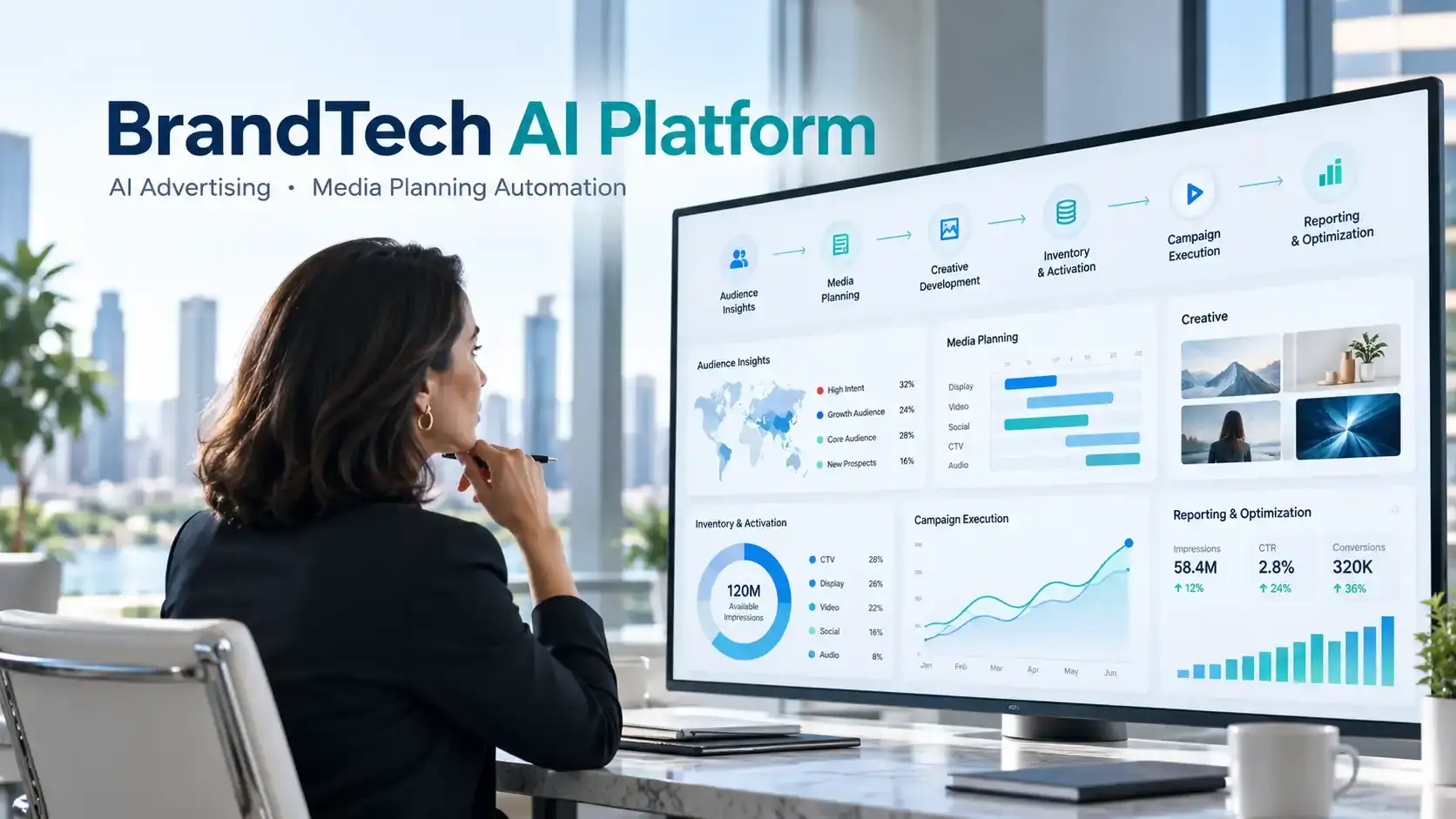
Business Goal → Audience → Media Strategy → Creative → Inventory → Execution → Optimization → Reporting
AI sits across that workflow to reduce manual work and make recommendations faster.
EraZero describes itself as an AI advertising platform connecting campaign planning and creative development with media such as OOH, in-app and transit. Its platform currently includes Steve AI as a campaign strategist and Sara AI as a creative assistant.
That’s a useful example of how BrandTech differs from a standalone generative-AI tool.
The goal isn’t just to create an ad.
It’s to help turn an advertising requirement into an executable campaign.
Why Traditional Advertising Workflows Need Automation
Consider a national brand preparing a product launch.
The team may need to:
- identify target audiences;
- choose cities;
- determine budgets;
- shortlist channels;
- find available inventory;
- compare locations;
- coordinate media owners;
- create format-specific artwork;
- secure approvals;
- launch campaigns;
- track execution;
- prepare reports.
Now multiply that across 10 cities and six media channels.
The problem isn’t a lack of data.
It’s fragmentation.
EraZero’s multi-channel advertising platform is built around this issue, bringing OOH, transit, in-app and other channels into a unified campaign workflow. The platform describes the traditional problem as teams moving between separate tools for planning, targeting, buying and creative execution.
That’s where media planning automation becomes particularly valuable.
Media Planning Automation Is More Than Picking Channels
AI media planning should not simply output:
“Use OOH and mobile.”
A useful system needs context.
What is the campaign objective?
Who is the audience?
Which cities matter?
How much budget is available?
What inventory exists?
What role should each medium play?
With media planning automation, repetitive parts of the process can be accelerated: location discovery, inventory exploration, campaign structuring and multi-location coordination.
For example, EraZero’s OOH automation workflow moves from campaign objective to AI-assisted location identification, inventory discovery, placement selection and campaign creation.
That doesn’t remove the media planner.
It changes what the planner spends time doing.
Less: searching spreadsheets and coordinating basic information.
More: deciding whether the recommendation makes strategic sense.

What Should an AI-Powered BrandTech Platform Actually Do?
Marketing leaders shouldn’t evaluate a platform simply because it uses the word “AI.”
Look at the workflow it solves.
1. Translate briefs into campaign structure
A strong platform should understand objectives, audiences, locations, budgets and channels and turn them into an actionable media brief.
2. Improve audience and location decisions
AI can help identify useful audience segments, geographies and media environments instead of making teams manually search every option.
3. Connect planning to real inventory
Recommendations are more useful when marketers can move from “you should advertise outdoors” to actual locations, screens or media opportunities.
4. Support creative development
Creative requirements change by format.
A billboard, metro wrap and mobile interstitial shouldn’t use exactly the same artwork.
EraZero’s platform pairs Steve AI for campaign strategy with Sara AI for creative support, helping connect planning and creative development within the same advertising ecosystem.
5. Coordinate multiple channels
Customers don’t live inside individual media silos.
They might see an OOH screen during a commute, encounter an in-app ad later and then interact with a retail activation.
A modern multi-channel AI advertising platform should help teams coordinate these channels rather than planning each independently. EraZero currently presents cross-channel planning across media including OOH, transit and in-app advertising from one platform.
6. Make execution visible
Enterprise teams also need operational control:
- campaign status;
- selected inventory;
- approvals;
- locations;
- budgets;
- execution reporting;
- multi-city coordination.
Automation becomes valuable when it improves these mundane but critical tasks, not only the glamorous parts of marketing.
BrandTech vs AdTech vs MarTech
The three concepts overlap, but they solve slightly different problems.
MarTech generally supports broader marketing operations such as CRM, email, customer journeys, analytics and automation.
AdTech traditionally focuses more directly on advertising delivery, media transactions, targeting and measurement.
BrandTech can be thought of as a brand-led layer that connects campaign intelligence, creative, media and execution.
For a marketing leader, the terminology matters less than the outcome.
The useful question is:
How much of our advertising workflow can this platform connect without sacrificing strategic control?

What BrandTech Means for Enterprise Brands and Agencies
The biggest benefit isn’t that AI makes every decision automatically.
It’s scale.
An enterprise marketing team may need campaigns across dozens of cities, media types and stakeholders.
An agency may need to repeat that process across multiple clients.
A connected platform can reduce repetitive coordination while giving planners a common campaign view.
That makes a BrandTech AI platform particularly relevant for:
- enterprise marketing teams;
- media agencies;
- brand managers;
- growth teams;
- multi-city advertisers;
- companies using both physical and digital media.
It also makes campaign knowledge less dependent on one spreadsheet or one employee knowing which vendor to call.
How EraZero Approaches BrandTech
EraZero AI positions BrandTech around bringing previously fragmented advertising workflows together.
Across the platform, brands can explore media spanning OOH, transit, in-app, retail, quick commerce, television, radio, cinema, print and other formats.
Its approach combines campaign strategy through Steve AI, creative support through Sara AI, media and inventory discovery, multi-channel planning and centralized campaign management.
EraZero’s OOH advertising automation platform, for example, is designed to replace manual location research, fragmented vendor coordination and spreadsheet-driven planning with AI-assisted inventory discovery and centralized workflows.
For marketing leaders, that’s the more meaningful promise of BrandTech:
not AI for the sake of AI, but fewer disconnected steps between an idea and a live campaign.