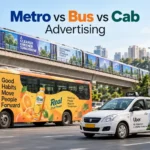
A consumer watches a new beverage ad while streaming a cricket match on the television at home.
The next morning, she sees the same brand on a digital screen during her commute.
At lunch, another version appears on a screen near a mall or business district.
That isn’t three unrelated impressions.
Done properly, it’s one connected brand experience.
This is why CTV and DOOH are becoming an interesting combination for Indian advertisers. Connected TV gives brands a premium large-screen experience inside the home. Digital Out-of-Home extends that visibility into airports, malls, metros, office districts, retail environments and city streets.
For consumer brands and agencies, the opportunity is bigger than buying two media channels. It’s about building cross-screen advertising around how people actually move through their day.
Why CTV Advertising in India Deserves a Cross-Screen Strategy
Connected TV is no longer a niche extension of digital video.
India now has an estimated 20 crore CTV users according to the 2026 DCODE 2.0 industry playbook, while connected viewing continues to take a larger role in premium digital video consumption.
JioStar has also said that CTV’s share of JioHotstar watch time increased from 20% in 2022 to 43% in 2026, showing how quickly viewing behaviour is shifting toward the television screen even within digital streaming.
For advertisers, that creates an important distinction.
Mobile video is personal and close.
CTV is larger, often shared and consumed in a lean-back environment.
EraZero’s JioHotstar CTV advertising offering, for example, includes pre-roll, mid-roll, billboard and CTV placements across entertainment, movies and live sports, with reach across mobile, web and connected television devices.
But CTV still happens primarily inside the home.
That’s where DOOH adds something different.
DOOH Takes the Campaign Into the Physical World
Digital OOH advertising uses digital screens in physical environments such as billboards, malls, airports, metro stations, transit hubs, retail locations and interactive kiosks.
Unlike static outdoor media, DOOH can support dynamic creatives, scheduling, different messages by location and more flexible campaign updates. EraZero’s current DOOH platform also supports audience-led screen selection, programmatic scheduling and centralized campaign management.
That makes DOOH a natural partner for connected TV ads.
CTV can introduce the story.
DOOH can reinforce it when the consumer leaves home.
The important part is that the two screens shouldn’t behave as separate campaigns.
CTV and DOOH Should Do Different Jobs
Imagine a premium coffee brand launching in Bengaluru.
The CTV campaign could use a 20-second film showing the morning ritual around the product. It has enough time and screen space to build mood, product recognition and desire.
The DOOH campaign shouldn’t simply take a screenshot from that film and place it on a billboard.
Instead, it might say:
“Your 4 PM coffee deserves an upgrade.”
That creative could run around office districts during afternoon hours.
Near premium residential neighbourhoods, the message could change again.
At a mall, it could highlight where the product is available.
Same campaign.
Same distinctive brand assets.
Different job for each screen.
That’s what makes cross-screen advertising more useful than simply increasing the number of placements.
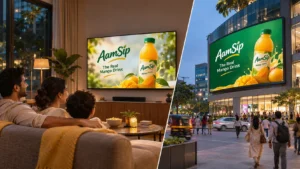
Build Frequency Without Repeating the Same Advertisement
One of the biggest advantages of combining CTV and DOOH is frequency across different contexts.
But frequency doesn’t mean showing exactly the same creative everywhere.
A better system uses a consistent visual identity while allowing each screen to contribute something new.
CTV can carry emotion and storytelling.
A digital billboard can deliver one bold message.
An airport screen can communicate premium positioning.
A metro display can build commuter frequency.
A retail DOOH screen can move closer to product consideration.
The consumer should recognize the campaign immediately without feeling as though they’ve seen the identical ad five times.
Plan Around Audience Moments, Not Just Media Formats
A strong CTV advertising India strategy starts with audience behaviour.
Ask when the audience watches, where they commute, where they shop and which physical environments matter to the category.
For a fintech brand, the combination might be:
CTV entertainment viewing at home + DOOH around technology parks and business districts.
For a beauty company:
CTV video + mall and retail digital screens.
For automotive:
premium streaming + airport roads, corporate corridors and high-visibility digital billboards.
For entertainment:
CTV trailers + metro, mall and nightlife DOOH.
EraZero’s location-led DOOH planning can identify screens based on audience profile, location, campaign objective and format rather than selecting digital screens purely because they are available.
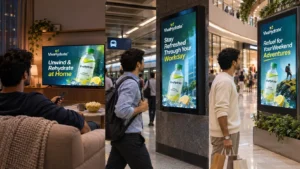
How Should Brands Measure CTV and DOOH Together?
This is where cross-screen planning becomes harder.
CTV and DOOH don’t generate exactly the same metrics.
CTV campaigns may evaluate impressions, completed views, reach, frequency and audience segments.
DOOH may use estimated impressions, screen delivery, location coverage, audience movement and campaign frequency.
Instead of forcing both channels into one identical KPI, define what each one contributes to the campaign.
For an awareness launch, that might mean evaluating combined reach and frequency.
For a retail campaign, DOOH exposure could be mapped around relevant stores while CTV builds wider awareness.
For a product launch, brands might compare geographic sales or search activity in markets receiving both CTV and DOOH against markets receiving only one.
The goal is not simply to report two dashboards next to each other.
It’s to understand whether the channels are reinforcing one another.
How EraZero AI Can Support Cross-Screen Campaign Planning
Managing CTV, DOOH and other media separately can quickly create fragmented planning.
One team handles streaming.
Another manages outdoor screens.
Different agencies control creative, inventory, budgets and reporting.
EraZero’s multi-channel advertising platform is designed to bring media such as OOH, DOOH, transit, in-app and TV into a more unified planning workflow. The platform supports cross-channel campaign planning, audience targeting, creative recommendations and centralized campaign management.
For brands planning CTV and DOOH, that creates a more useful starting point:
Campaign objective → Audience → Screen strategy → Locations → Creative → Execution
Rather than beginning with:
“How much CTV should we buy?”
or
“Which digital billboards are available?”
Start with:
“Which screen should influence the customer at each moment?”
That’s ultimately what a good cross-screen strategy is about.
Not being everywhere.
Being recognizable in the right places, on the right screens, at the right moments.