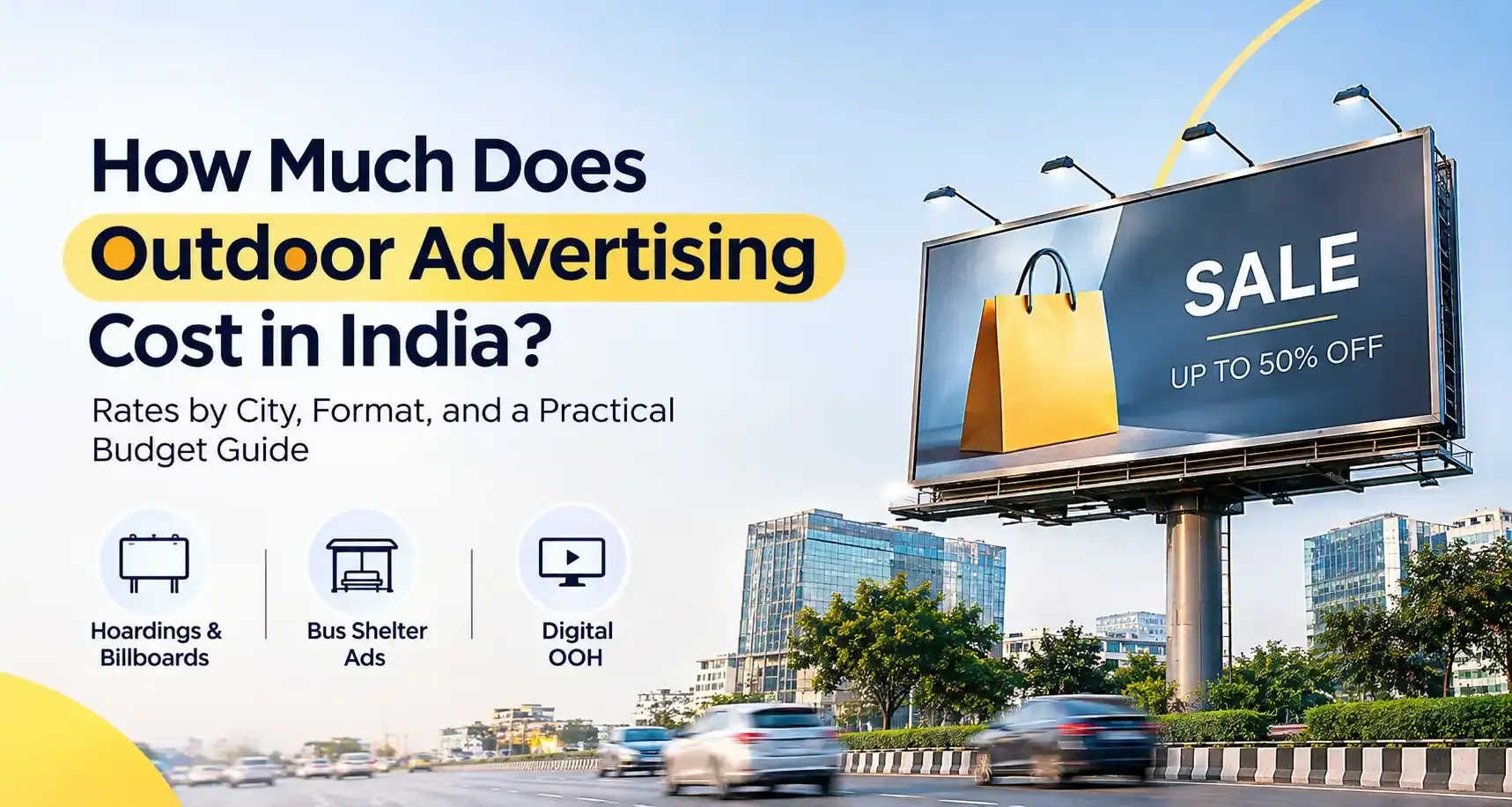
A hoarding on a busy Mumbai road and a billboard near a neighbourhood market might look similar. Their prices rarely are.
When comparing outdoor advertising cost in India, the useful question isn’t simply “How much does a billboard cost?” It is “What will this location deliver for my budget?”
Out-of-home (OOH) advertising covers hoardings, digital screens, bus shelters and transit placements. Prices vary by city, audience and duration.
This guide explains billboard prices, hoarding advertising rates and the costs that don’t always appear in the first quotation.
Outdoor Advertising Cost in India: City-Wise Rates
The following 2026 market benchmarks cover monthly hoarding rentals, from standard urban locations to premium advertising corridors.
| City | Indicative hoarding cost per month |
| Mumbai | ₹1.5 lakh–₹20 lakh+ |
| Delhi NCR | ₹1.2 lakh–₹7.5 lakh+ |
| Bengaluru | ₹1 lakh–₹6 lakh+ |
| Hyderabad | ₹90,000–₹4.5 lakh+ |
| Chennai | ₹90,000–₹3.75 lakh+ |
| Kolkata | ₹80,000–₹3.75 lakh+ |
| Pune | ₹60,000–₹5.5 lakh+ |
| Ahmedabad | ₹60,000–₹2.25 lakh+ |
These are indicative market ranges, not live EraZero quotations. Printing, mounting and taxes may cost extra.
In Tier-2 cities such as Jaipur, Indore and Lucknow, hoarding rates may range from approximately ₹50,000 to ₹3 lakh monthly. Smaller-town placements can start around ₹15,000, depending on location and size.
Mumbai’s BKC may suit business audiences, while Bengaluru’s Whitefield and Outer Ring Road can reach working professionals. The best placement isn’t necessarily the most expensive. It’s the one your customers actually pass.
Outdoor Advertising Rates by Format
The outdoor advertising budget also changes significantly depending on the medium.
| OOH Format | Indicative monthly metro rate | Best suited for |
| Static hoardings or billboards | ₹1.5–₹10 lakh | Brand awareness and repeated visibility |
| Bus shelter advertising | ₹15,000–₹60,000 per shelter | Hyperlocal street-level reach |
| Bus panel branding | ₹15,000–₹50,000 per bus | Moving neighbourhood coverage |
| Metro station advertising | ₹50,000–₹5 lakh | Commuter-focused campaigns |
| Digital OOH screens | ₹60,000–₹10 lakh+ | Dynamic creatives and timed campaigns |
These broad ranges are planning benchmarks rather than fixed rates.
An important distinction is how digital media is sold. Digital OOH advertising may be priced by advertising slot, play frequency, screen network or campaign duration. Paying for a slot doesn’t necessarily mean exclusive use of the screen.
For local retailers, bus shelter advertising provides neighbourhood visibility. Brands that need multiple creatives or scheduled messaging can explore digital OOH advertising.
What Determines Hoarding Advertising Rates?
Two billboards with identical dimensions can have very different prices. Understanding why helps advertisers evaluate quotations more effectively.
1. Location and audience
A premium junction generally costs more than a quieter road because of visibility and advertiser demand.
However, high traffic doesn’t automatically mean a relevant audience. A jewellery brand, educational institution and industrial supplier need different locations.
2. Size, lighting and visibility
Large unipoles, illuminated billboards and overhead gantries generally cost more than non-lit panels.
Before booking, consider road-facing direction, viewing distance and possible obstructions from trees or nearby structures.
3. Campaign duration and demand
Static hoardings are commonly booked in approximately 30-day cycles.
Longer commitments may reduce the effective monthly rate. Conversely, festivals, product launches and high-demand advertising periods can influence pricing and availability.
4. Static versus digital advertising
A static hoarding generally displays one campaign continuously during its booked period.
Digital billboards often rotate multiple advertisements. Their pricing depends on spot duration, scheduling and the number of plays.
For example, when comparing billboard advertising in Bengaluru, evaluate the audience, location and road-facing visibility alongside the quoted price.
Hidden Costs: What Should Your Outdoor Advertising Budget Include?
The media rental is often only the starting figure.
Before approving a quotation, confirm whether the advertiser must separately pay for creative adaptation, printing, installation, permissions, monitoring, maintenance and removal.
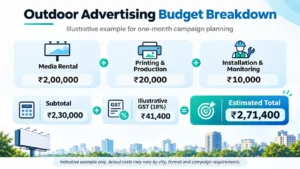
Consider this illustrative one-month outdoor campaign budget:
| Cost Component | Example Amount |
| Hoarding rental | ₹2,00,000 |
| Printing and production | ₹20,000 |
| Installation and monitoring | ₹10,000 |
| Subtotal | ₹2,30,000 |
| GST at an illustrative 18% | ₹41,400 |
| Estimated total | ₹2,71,400 |
This example demonstrates how the final campaign expenditure can differ from the advertised rental price. Actual charges and tax treatment must be confirmed with the supplier.
A low-cost location isn’t automatically economical if poor visibility reduces the campaign’s value.
How to Plan an Outdoor Advertising Budget Effectively
Start with the campaign objective rather than the largest billboard available.
For a new clinic, a network of relevant neighbourhood placements may be more useful than one expensive city-centre hoarding.
A consumer brand launching across a metro might combine a flagship billboard with smaller placements that create repeated exposure.
Before spending, use this five-point checklist:
- Define your target audience. Identify neighbourhoods, commute routes, retail catchments and business districts.
- Evaluate actual inventory. Request site photographs, board dimensions, facing details and permission status.
- Compare total campaign costs. Include production, installation, duration and applicable taxes.
- Verify campaign execution. Confirm display dates, installation photographs and monitoring arrangements.
- Measure value beyond price. Consider estimated reach, audience relevance and cost efficiency.
Media planners can also use CPM and CPT in outdoor advertising to compare costs against estimated audience exposure.
For small businesses, concentrated visibility in relevant locations is often a better starting point than spreading a limited budget across unrelated areas.
How EraZero AI Helps Plan Outdoor Advertising Campaigns
Choosing outdoor advertising inventory becomes more complicated when campaigns involve multiple cities, formats and media owners.
EraZero AI brings advertising planning and inventory discovery into a more centralized workflow.
Through its AI media planning platform, Steve AI helps marketers translate campaign objectives, audiences, budgets and locations into media recommendations.
Instead of beginning with disconnected supplier spreadsheets, brands can explore relevant inventory, compare opportunities and structure their campaigns around actual business requirements.
Whether you’re evaluating one billboard or planning a multi-city OOH campaign, understanding both pricing and audience suitability is essential.
Ready to plan your next campaign? Explore EraZero’s advertising solutions to shortlist relevant outdoor media and request current location-wise pricing.