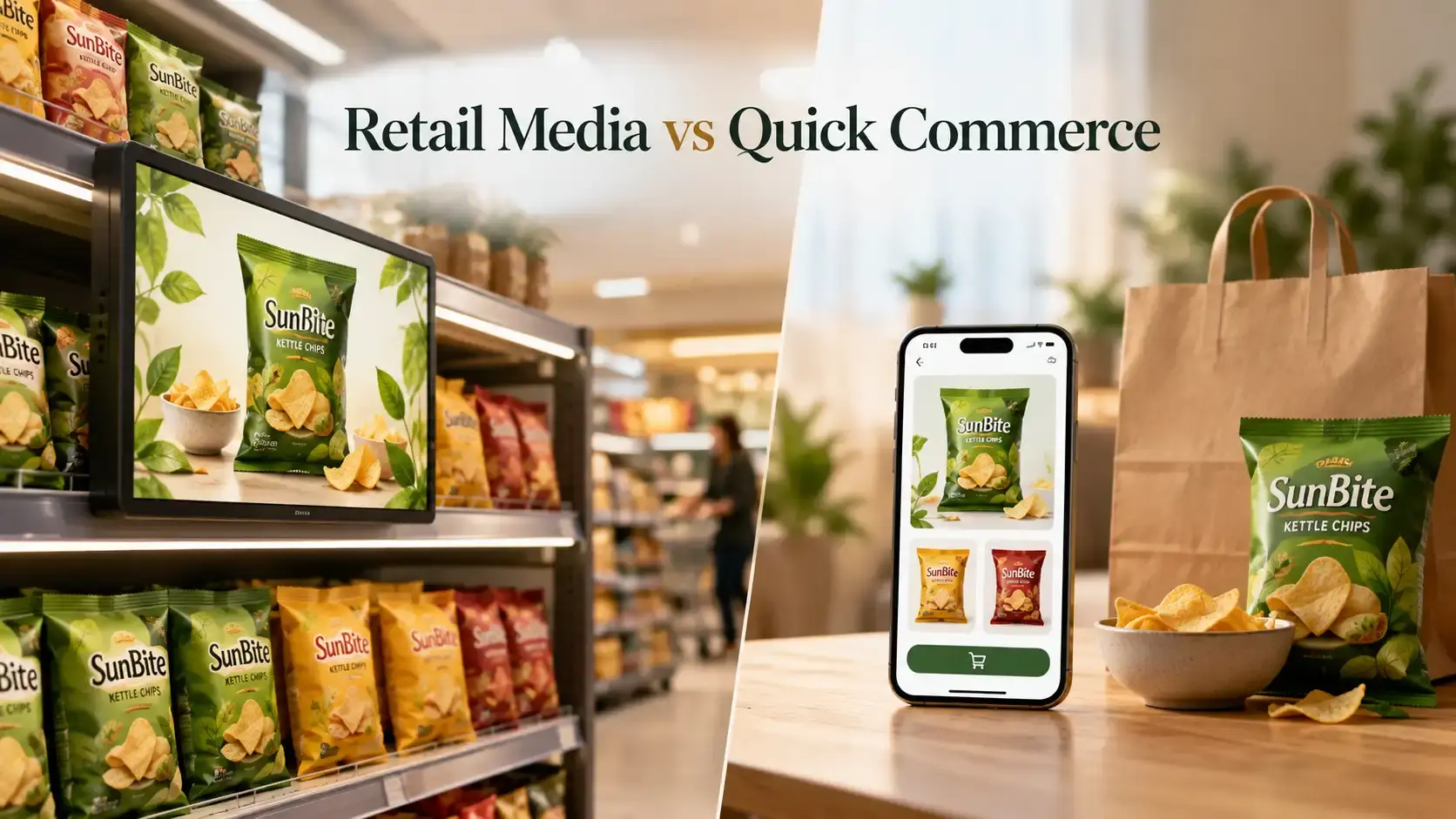
An FMCG brand launching a new beverage, snack, skincare SKU or household product has more commerce-media options than ever.
You can advertise inside a retail environment where shoppers are already comparing products. Or you can reach consumers through Blinkit, Zepto, Swiggy Instamart and last-mile delivery ecosystems when the path from discovery to purchase may be only a few taps long.
So which deserves more budget?
Retail media or quick commerce advertising?
The answer isn’t that one channel is universally better.
For FMCG brands, the smarter choice depends on what the campaign needs to do: build category visibility, drive trials, support a launch, win the digital shelf, increase basket consideration or generate hyperlocal sales.
Understanding that difference is the key to building a stronger commerce media strategy.
What Is Retail Media?
Retail media is advertising that uses a retailer’s shopping environment, customer touchpoints or retail audience to influence purchase decisions.
It can include:
- in-store digital screens;
- shelf and aisle branding;
- point-of-sale advertising;
- mall and retail displays;
- sponsored product placements;
- ecommerce banners;
- retailer-owned digital inventory.
EraZero’s retail advertising solutions include opportunities designed to influence shoppers within retail and shopping environments. EraZero also positions retail advertising around shelf and aisle branding, digital retail displays and shopper-engagement strategies.
For FMCG marketers, the appeal is obvious.
The consumer isn’t simply part of your demographic.
They’re already shopping.
A cereal advertisement beside the breakfast aisle, a cosmetics display inside a mall or a sponsored product inside a retailer’s digital experience reaches the customer much closer to the purchase decision than a broad awareness impression.
What Is Quick Commerce Advertising?
Quick commerce advertising reaches consumers through rapid-delivery ecosystems and the moments surrounding an active purchase.
EraZero supports formats including:
- product sampling;
- order inserts;
- carry-bag branding;
- coupon and pamphlet distribution;
- delivery sponsorships;
- hyperlocal activations.
The platform describes quick commerce as a way to reach consumers during active purchase moments while using delivery zones and last-mile touchpoints for hyperlocal targeting.
There is also the digital side.
FMCG brands can use Blinkit in-app advertising across search results, category pages and homepage placements, while Zepto in-app advertising includes banners, videos and sponsored listings throughout shopping journeys.
EraZero’s Swiggy Instamart advertising similarly covers banners, native advertising and sponsored listings across product discovery and grocery-shopping environments.
So quick commerce isn’t just another digital ad channel.
It combines shopping intent, hyperlocal distribution and extremely short purchase journeys.
Retail Media vs Quick Commerce: The Practical Difference
The easiest way to separate them is by thinking about the consumer moment.
| Factor | Retail Media | Quick Commerce Advertising |
| Core environment | Store, mall or retailer ecosystem | Fast-delivery and q-commerce ecosystem |
| Consumer mindset | Browsing, comparing, shopping | Immediate purchase intent |
| Strong use case | Visibility and category influence | Conversion, trial and hyperlocal activation |
| Physical formats | Screens, shelves, POS | Samples, inserts, bags, delivery activations |
| Digital formats | Sponsored products, retail banners | Search, category, sponsored listings, banners |
| Geography | Store/catchment based | Delivery-zone based |
| Useful for FMCG | Always-on presence | Launches, trial and fast conversion |
There is overlap, which is important.
Quick commerce can itself function as retail media, because platforms such as Blinkit or Zepto are retailers with owned digital shopping environments.
But from a campaign-planning perspective, brands often treat quick commerce separately because its delivery speed, hyperlocal structure and last-mile activation options create a very different marketing opportunity.
When FMCG Brands Should Invest More in Retail Media
Retail media makes particular sense when the objective is consistent shopper visibility.
Imagine a personal-care company with products available across hundreds of stores.
Its challenge isn’t necessarily introducing the category.
It may need to win attention when consumers are standing in front of ten competing products.
Retail advertising can help by reinforcing:
- packaging recognition;
- new variants;
- price promotions;
- premium positioning;
- category leadership;
- seasonal communication.
It is also well suited to brands with wider portfolios.
A large FMCG company may want to support several SKUs instead of pushing one hero product.
Retail media gives those brands multiple points of influence throughout the shopping journey.
This is especially valuable when the purchase decision still involves comparison.
When Quick Commerce Marketing Is the Stronger Choice
Quick commerce marketing becomes especially interesting when speed and trial matter.
Consider a beverage company launching a new flavour.
The brand wants people in selected Bengaluru neighbourhoods to:
see it → try it → reorder it.
Quick commerce can support that journey unusually well.
The brand might combine:
Sponsored listing inside a commerce app
Product sampling inside relevant orders
Coupon insert encouraging the next purchase
That moves beyond impressions into physical product interaction.
EraZero’s quick-commerce offering specifically positions sampling and inserts as tools for FMCG launches and category awareness, with campaigns deployable across metro, Tier-1 and Tier-2 markets and residential delivery clusters.
The channel can be particularly useful for:
- new SKU launches;
- beverages;
- snacks;
- beauty and personal care;
- health products;
- impulse categories;
- products that benefit from sampling.
Don’t Choose Based Only on Conversion
It’s tempting to assume quick commerce wins because it’s closer to the transaction.
But that misses an important part of FMCG advertising.
Consumers don’t always buy the first brand they see in an app.
Brand familiarity still matters.
Retail presence still matters.
Packaging recognition matters.
Repeated exposure matters.
A consumer may first notice a snack on a retail screen, see it again while shopping online and eventually add it to a quick-commerce basket.
That means the strongest strategy can be:
Retail media creates familiarity. Quick commerce captures intent.
This is why FMCG teams should avoid evaluating every channel using exactly the same KPI.
Use retail media metrics such as:
- reach;
- shopper exposure;
- category visibility;
- engagement;
- footfall where measurable.
For quick commerce, look harder at:
- impressions;
- product-page visits;
- add-to-cart activity;
- sales;
- sampling volumes;
- coupon usage;
- repeat purchase.

Where Should FMCG Brands Actually Put Their Budget?
For a new FMCG launch, I would structure the decision around the campaign objective rather than forcing a 50/50 channel split.
If trial and rapid customer acquisition are the priority, put more weight behind quick commerce.
If brand presence and sustained shopper influence matter more, retail media deserves a larger role.
If you’re launching nationally, the two can complement each other.
For example:
Phase 1: Retail and high-visibility media build awareness.
Phase 2: Quick-commerce sponsored placements capture active shoppers.
Phase 3: Sampling and order inserts encourage product trial.
Phase 4: Performance data identifies cities and audiences worth scaling.
That’s a much stronger approach than asking which single medium is “best.”
How EraZero AI Fits Into the Commerce Media Mix
EraZero AI is built to help marketing teams plan advertising across multiple media environments instead of managing every channel separately.
Its AI media planning platform allows marketers to define audience, objective and budget before receiving media recommendations and structuring campaigns.
For brands running both retail and quick-commerce campaigns, EraZero’s multi-channel advertising platform is designed to coordinate channels and campaign decisions from one planning environment.
For FMCG teams, that means the decision doesn’t have to be:
Retail media OR quick commerce.
The more useful question is:
Which channel should do which job in the customer journey?
That’s where modern commerce media planning becomes more effective.