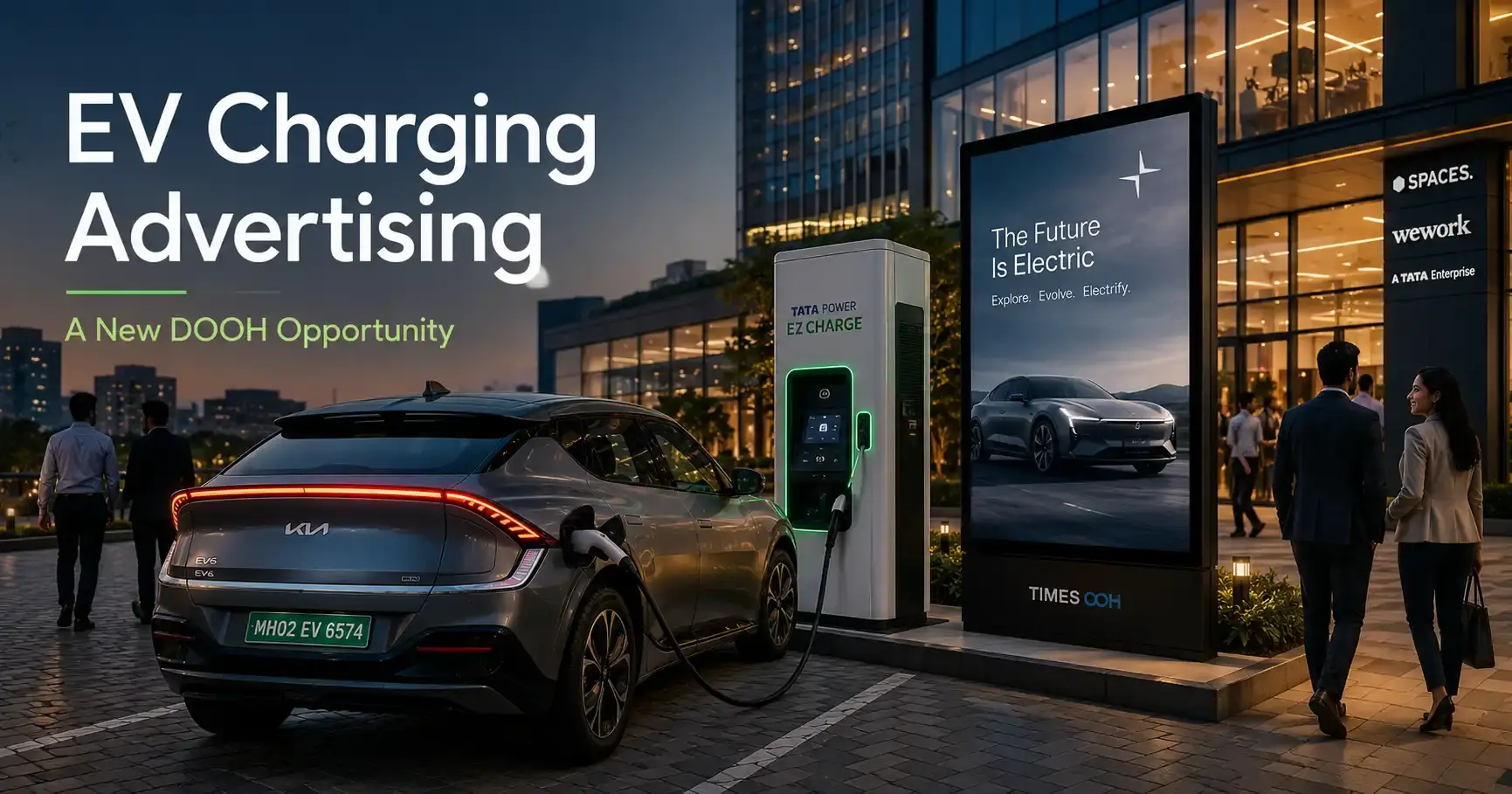
An electric vehicle pulls into a shopping mall parking area. The driver plugs in, checks the charging status, then has something most outdoor advertisers rarely get:
time.
They might walk toward the mall. They might wait nearby. They may check their phone, grab a coffee, or return to the vehicle before charging finishes.
That makes the charging environment interesting from a media perspective.
EV charging advertising turns charging stations, nearby digital screens and charging destinations into advertising touchpoints—giving brands an opportunity to reach an increasingly valuable urban audience in a context built around mobility, technology and sustainability.
For automotive, fintech, technology and premium consumer brands, this is becoming one of the more interesting new DOOH formats to watch.
But there’s an important distinction: not every EV charger is automatically advertising inventory. The opportunity depends on the charging network, screen configuration, property owner, location and media rights.
So, can brands advertise at electric vehicle charging stations?
Yes—but the media strategy matters as much as the charger itself.
Can Brands Advertise at EV Charging Stations?
Yes. Advertising can appear directly on screen-equipped chargers, on digital displays beside charging bays, through branded charging infrastructure or across media screens positioned within the surrounding destination.
This isn’t just theoretical.
ChargePoint, for example, supports advertising and promotional content on high-resolution screens on several of its charging-station models.
EV-charging media networks have also developed large-format DOOH screens around chargers in retail and commercial locations. Volta—now part of JOLT’s media proposition—has used charging stations as a place-based digital media network designed to reach drivers, shoppers and nearby pedestrian audiences.
That makes charging station ads part of a broader evolution of place-based DOOH.
The charger is the anchor.
The media opportunity can extend beyond the person physically plugging in the vehicle.
Why Charging Environments Create a Different DOOH Opportunity
A traditional roadside billboard has seconds to communicate.
An EV charging environment can create a different kind of attention window.
The audience is temporarily anchored to a location
Charging times vary significantly depending on the vehicle, charger type and battery state, so brands shouldn’t build campaigns around one assumed dwell-time number.
The important point is simpler:
the vehicle has stopped.
That opens opportunities for longer-form or sequential communication compared with a passing roadside placement.
Location can be more valuable than the charger itself
Think about where public and destination chargers can appear:
- Shopping malls
- Premium residential complexes
- Corporate parks
- Hotels
- Retail destinations
- Restaurants and cafés
- Highway rest stops
- Commercial districts
- Parking facilities
- Automotive hubs
A charger at a premium mall and a charger at a highway stop create completely different audience contexts.
Strong EV charging advertising starts with the destination, not simply with the charging-unit count.
The environment already carries a technology signal
Charging infrastructure naturally sits at the intersection of:
mobility + technology + energy + sustainability
That context can strengthen the relevance of technology, automotive, financial and premium-product messaging.
It’s one reason new DOOH formats such as charging-station media can add something different to a conventional outdoor plan.
EV Charging Advertising Formats Brands Can Use
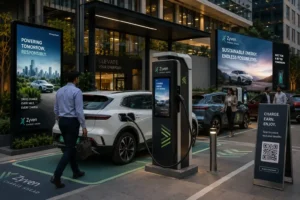
The exact inventory will vary by charging operator and location, but brands can think about the channel through several possible formats.
1. Digital screens integrated into charging stations
Where chargers include advertising-capable screens, brands may be able to run:
- Static digital creatives
- Short video
- Product messages
- Offers
- QR-led campaigns
- Contextual messages
Some established charging networks already support this type of charger-screen advertising.
Creative needs to stay simple.
Even if people spend several minutes at the location, they aren’t standing there specifically to watch an advertisement.
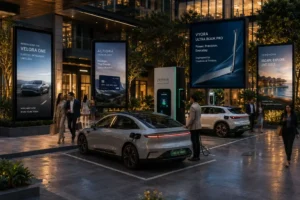
2. Large-format digital screens beside charging bays
This is where the channel starts to behave more like conventional Digital OOH advertising.
Large portrait or landscape screens can reach:
- EV drivers
- Passengers
- Shoppers
- Pedestrians
- Other motorists
These placements can be especially interesting when the charging bays sit near mall entrances, supermarkets, entertainment destinations or other commercial environments.
3. Branded charger panels and station wraps
Not every campaign needs motion.
Physical charger branding can include:
- Side panels
- Charging-unit wraps
- Bay branding
- Floor graphics
- Directional signage
- Charging-area takeovers
ChargePoint itself offers custom station graphics in addition to screen-based content.
For a sustainability-led or automotive brand, even the infrastructure can become part of the story.
4. Interactive and QR-enabled charging station ads
A simple QR code can connect the physical placement with:
- Test-drive booking
- App downloads
- Credit-card applications
- Product launches
- Store offers
- Lead forms
- Event registrations
The CTA needs to match the environment.
“Learn more” is weak.
“Book your EV test drive” gives the person a reason to act.
5. Dynamic and programmatic DOOH
Where inventory and technology support it, charging station ads can potentially become part of a programmatic DOOH plan.
Creative could vary based on:
- Location
- Time of day
- Day of week
- Campaign period
- Nearby retail context
- Weather
- Audience strategy
EraZero’s guide to DOOH advertising in India explains how digital outdoor media can use dynamic creative, location targeting and more flexible campaign scheduling.
Which Industries Fit the Electric Vehicle Audience?
The obvious answer is automotive.
But stopping there misses much of the opportunity.
Automotive brands
EV launches are a natural fit.
Campaign ideas include:
- New EV launches
- Test drives
- Vehicle upgrades
- Charging solutions
- Insurance
- Accessories
- Service plans
An automotive brand can reach someone while they are literally participating in the EV ecosystem.
That context is difficult to reproduce elsewhere.
Fintech and financial services
The electric vehicle audience can also be relevant for:
- Premium credit cards
- Digital banking
- Vehicle finance
- Investment products
- Insurance
- Rewards programs
The creative should still be site-specific. A premium shopping destination may justify a different financial product than a highway charging location.
Technology brands
Technology companies can use EV charging advertising for:
- Smartphones
- Laptops
- Wearables
- SaaS products
- Smart-home devices
- Connected-car technology
- Consumer electronics
The combination of a technology-led audience context and additional dwell time makes the environment particularly interesting for launches.
Premium and lifestyle brands
Luxury watches, travel, hospitality, premium retail, high-end real estate and lifestyle brands may also fit certain charging destinations.
But don’t assume every electric vehicle audience is automatically affluent.
Audience quality depends heavily on:
- Geography
- Vehicle mix
- Charger type
- Property
- Nearby retail
- Time of day
Premium location selection beats demographic assumptions.
How to Plan an EV Charging Station Campaign
1. Start with the location
Before asking, “How many screens can we buy?” ask:
Where are the chargers?
Map each site against:
- Audience profile
- Nearby businesses
- Traffic
- Dwell environment
- Property type
- Brand relevance
2. Define the campaign objective
Choose one primary goal:
- Awareness
- Product launch
- Lead generation
- Test-drive bookings
- App installs
- Store visits
- Premium brand positioning
3. Match creative to the charging moment
Good charging station ads should understand the environment.
An EV manufacturer could say:
Your next charge could be in your next EV.
A fintech brand could promote charging rewards.
A technology company could introduce a product built around mobility.
Context makes the screen feel less random.
4. Keep the visual architecture simple
For most DOOH creative:
- Lead with one message
- Use large type
- Limit body copy
- Prioritize product visibility
- Use one CTA
- Keep QR codes clearly separated
5. Combine charging media with other channels
EV charging screens don’t need to carry the entire campaign.
They can complement:
- Digital billboards
- Mall DOOH
- Corporate-park screens
- In-app advertising
- Mobile retargeting
- Retail media
- Social campaigns
EraZero’s AI media planning platform is designed to help marketers structure campaigns around audience, location, media mix and available OOH opportunities instead of planning each channel independently.
How to Measure Charging Station Ads
Measurement should start before the campaign runs.
Depending on the media owner and campaign setup, track:
- Screen plays
- Estimated impressions
- Location performance
- QR scans
- Landing-page sessions
- App downloads
- Lead submissions
- Test-drive requests
- Offer redemptions
- Store visits where measurable
Programmatic and data-enabled charging networks have already explored impression-based buying, audience targeting and sales or retail measurement, showing how the format can move beyond simple screen visibility.
The useful question isn’t:
How many people passed the charger?
It’s:
Did this charging location reach the right audience and create a measurable next action?
Your Next Steps: Treat the Charger as a Context, Not Just a Screen
The most interesting thing about EV charging advertising isn’t that someone found another place to install a display.
It’s the context around that display.
A vehicle has stopped.
The customer is in a mobility environment.
The location may sit beside retail, offices, hospitality or entertainment.
And the infrastructure itself signals technology and change.
For your first campaign:
- Identify advertising-enabled charging locations.
- Evaluate the audience around each destination.
- Prioritize sites that match your brand.
- Select the right screen or physical format.
- Create one contextually relevant message.
- Add a measurable response path.
- Integrate the placement with your wider DOOH and digital plan.
- Compare locations before scaling.
That’s why EV charging media belongs on the list of new DOOH formats worth testing.
Not because every charger should become an advertising screen.
But because the right charger, in the right destination, can create a highly relevant moment between a brand and an increasingly important urban electric vehicle audience.