Radio advertising continues to be one of the most effective ways for brands to reach local audiences with speed, frequency, and familiarity. In a market like India, where cities, languages, commute patterns, and buying habits change from region to region, radio gives brands a powerful local voice.
For local businesses, automotive brands, retail brands, real estate developers, and FMCG companies, radio advertising is not just about playing a 20-second or 30-second ad. It is about creating repeat exposure, building trust, and staying present in the daily routine of listeners.
From morning commuters to shop owners, office-goers, homemakers, cab drivers, and weekend shoppers, FM advertising in India allows brands to reach audiences during high-attention moments across the day.
Why Radio Advertising Still Works in India
Radio works because it is local, frequent, and personal. Unlike many digital ads that users skip or scroll past, radio ads reach people while they are driving, travelling, working, shopping, or relaxing. The brand message becomes part of their daily environment.
A strong radio advertising strategy helps brands create awareness without needing the audience to look at a screen. This makes radio especially valuable for businesses that want to reach people during commute hours, local market visits, regional events, festive seasons, and city-specific sales campaigns.
Radio also has an emotional advantage. A familiar voice, catchy jingle, repeated offer, or RJ mention can create stronger memory than a one-time visual ad. For brands trying to build local recall, that repetition matters.
Who Should Use Radio Advertising?
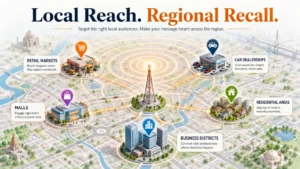
Radio ads are useful for brands that need quick awareness across a city or region.
Local businesses can use radio to promote store openings, seasonal offers, weekend sales, restaurant launches, clinics, coaching centres, gyms, and local services.
Automotive brands can use FM radio advertising to promote new vehicle launches, dealership offers, test-drive campaigns, service camps, exchange bonuses, and festive finance schemes. These campaigns can also be supported with outdoor advertising near dealerships, highways, malls, and high-traffic roads to improve recall.
Retail brands can use radio ads to drive footfall to malls, supermarkets, electronics stores, jewellery outlets, apparel stores, furniture showrooms, and shopping events. For retail-led campaigns, radio can work well with retail advertising and local store promotions.
Real estate brands can promote project launches, open house weekends, location benefits, limited-period offers, and site visit campaigns. Radio can also be combined with transit media advertising to reach commuters near project corridors and business districts.
FMCG brands can use radio to build regional awareness, support product launches, announce sampling campaigns, and create stronger brand recall in local markets.
Key Benefits of FM Advertising India
The biggest benefit of radio advertising is frequency. A listener may hear the same brand message multiple times across the week, which increases recall. For local campaigns, repetition is often more valuable than one high-cost media burst.
Another benefit is regional relevance. Radio ads can be produced in local languages and adapted to local culture, festivals, humour, and audience behaviour. A campaign in Bengaluru may need a different tone from a campaign in Pune, Hyderabad, Chennai, Jaipur, or Lucknow.
Radio also offers flexibility. Brands can choose morning, afternoon, evening, or weekend slots based on their target audience. A retail brand may focus on weekend shopping hours, while an automotive brand may focus on morning and evening commute slots.
For brands planning multi-channel campaigns, radio can be used along with in-app advertising to extend audio recall into mobile engagement.
Radio Advertising Formats Brands Can Use
A good radio campaign planning approach should choose the format based on the objective.
Spot ads are standard pre-recorded ads that run during selected time bands. These are useful for offers, launches, store announcements, and brand awareness.
RJ mentions allow radio presenters to talk about the brand in a more natural voice. This can help build trust because the message feels conversational.
Jingles are useful for recall. A simple, catchy tune can make a brand easier to remember, especially for retail, FMCG, education, healthcare, and local services.
Sponsorships allow a brand to associate with a show, segment, contest, traffic update, weather update, or festival special. This gives the brand repeated visibility across a relevant content environment.
Contest-led campaigns can improve listener engagement by asking audiences to call, message, answer questions, visit stores, or participate in brand activities.
How to Build a Strong Radio Advertising Strategy
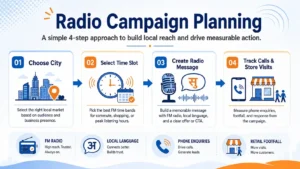
A radio advertising strategy should begin with the campaign goal. Is the brand trying to build awareness, increase store visits, promote a sale, drive test drives, launch a product, or improve local recall?
Once the goal is clear, the next step is market selection. Brands should choose cities and regions based on business presence, audience density, language, buying potential, and competitive activity.
The third step is message planning. Radio messages must be simple and memorable. A listener may not be able to write down a long URL or complex offer while driving. The ad should focus on one key benefit, one offer, one location, or one action.
The fourth step is frequency planning. A radio campaign should run often enough for the audience to remember the message. Short campaigns with low frequency may not create strong recall.
The final step is integration. Radio performs better when combined with OOH advertising, in-app ads, print advertising, retail activations, social media, and local landing pages. Radio creates audio recall, while other channels help drive action.
How Brands Can Measure Radio Advertising Results
Radio advertising is often seen as difficult to measure, but brands can track results with the right planning. Dedicated phone numbers, campaign-specific landing pages, QR codes in supporting print or OOH ads, unique offer codes, store visit tracking, and sales lift analysis can help measure campaign impact.
For example, an automotive dealer can track test-drive enquiries during the campaign period. A retailer can measure footfall during sale days. A real estate brand can track site visit bookings. An FMCG brand can compare sales movement in campaign cities versus non-campaign cities.
The goal is not to measure radio only by clicks. Radio should be measured by reach, frequency, recall, enquiries, visits, and business impact.
For stronger measurement, brands can connect radio with digital and in-app campaigns to retarget users after audio exposure and improve campaign action.
How EraZero Helps Brands Plan Radio Campaigns
EraZero brings radio advertising into a broader AI-powered media planning approach. Brands can explore radio along with OOH, in-app, cinema, print, retail, TV, transit, and other advertising channels in one integrated planning ecosystem.
For brands that want to run radio advertising in India, EraZero can help simplify campaign planning by aligning audience, geography, media format, creative requirements, and campaign objective. This helps brands move from scattered media buying to more structured radio campaign planning.
Whether the campaign is for a local store, a car dealership, a real estate launch, or an FMCG product, EraZero helps brands think beyond isolated radio spots and plan radio as part of a complete local advertising strategy.
Brands can also combine radio with cinema advertising for local entertainment audiences, TV advertising for mass awareness, and quick commerce advertising for consumption-led FMCG campaigns.
Final Thoughts
Radio advertising remains powerful because it combines local reach, repeated exposure, emotional connection, and regional relevance. For brands that want to improve local recall, radio can become one of the most dependable channels in the media mix.
The best radio campaigns are not just heard. They are remembered. With the right message, frequency, language, and media planning, brands can use radio advertising in India to build stronger awareness, trust, and action across local markets.