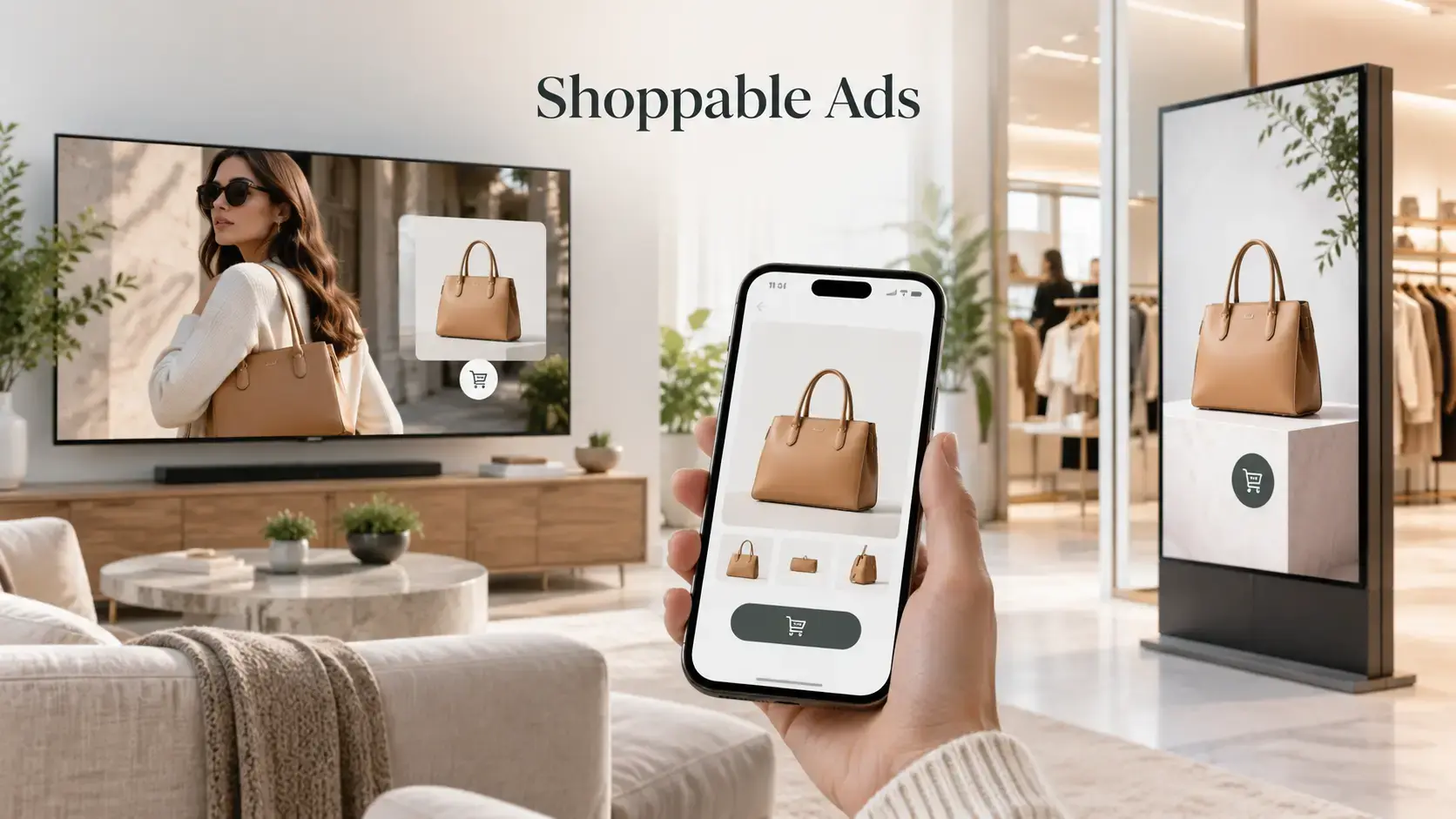
Advertising used to have a fairly clean job.
Get attention. Build memory. Hope the customer remembers you later.
Commerce has changed that.
A shopper can now discover a product while watching television, browsing a mobile app or standing inside a store — and move toward purchase almost immediately.
That shift is behind the rise of shoppable ads.
Instead of ending with “Visit our website,” the ad itself creates the next step: tap the product, scan a QR code, open a product page, add to cart or interact with a retail display.
For ecommerce brands, retailers and D2C marketers, this changes the role of media.
Advertising is no longer always separated from shopping.
Increasingly, the ad itself can become part of the store.
What Are Shoppable Ads?
Shoppable ads are advertising formats that allow people to move directly from seeing a product to taking a commerce action.
Depending on the screen, that action could mean:
- tapping Shop Now;
- opening a product page;
- viewing a catalogue;
- adding an item to cart;
- scanning a QR code;
- receiving a product link;
- interacting with an in-store screen;
- finding the product inside a shopping app.
The important part isn’t the button.
It’s the reduction in distance between interest and purchase.
Traditional advertising often looks like:
Ad → Remember brand → Search later → Find product → Purchase
Shoppable advertising tries to shorten that journey:
Ad → Product → Action
That’s why commerce advertising is moving beyond ecommerce websites and social feeds into connected TV, mobile apps, quick-commerce platforms and physical retail environments.
Shoppable CTV Ads Turn the Living Room Into a Commerce Touchpoint
Connected TV has traditionally been an awareness medium.
Big screen. Strong storytelling. Broad reach.
But CTV shopping ads are adding another layer: interaction.
A viewer may see a product during streaming content and then scan a QR code, send the product to their phone or use an interactive prompt to explore it.
For brands, that opens up interesting possibilities across:
- beauty;
- fashion;
- home and furniture;
- electronics;
- food and beverage;
- D2C products;
- entertainment commerce.
Imagine watching a skincare commercial and being able to explore the featured serum immediately.
Or seeing a furniture collection on a streaming platform and scanning a QR code to view the products without having to search for the brand later.
What makes CTV shopping ads work?
The product needs to be understandable quickly.
The CTA should also be simple.
Don’t place four different actions on the screen. Give viewers one obvious next step.
And remember: a weak television commercial doesn’t suddenly become effective because somebody added a QR code.
The creative still has to earn attention first.
For brands looking at video and connected-screen opportunities, EraZero also supports advertising across digital and app-based media environments as part of its broader multi-channel advertising platform.
Mobile Is Where Shoppable Advertising Feels Most Natural
Mobile is arguably the most natural home for shoppable advertising.
The user already has the screen in their hand.
They can see the product, explore it and buy it without changing devices.
But marketers shouldn’t think only about conventional social ads.
The bigger commerce opportunity often exists where people are already displaying buying intent.
Think quick commerce.
On platforms such as Blinkit, Zepto and Swiggy Instamart, users aren’t casually browsing content. They’re actively searching, comparing and building baskets.
That changes the value of the advertising moment.
EraZero’s Zepto advertising offering, for example, includes homepage, product-listing and checkout-oriented placements, alongside banner, video, sponsored listing and interactive formats.
Similarly, Blinkit advertising can reach consumers while they are actively browsing and purchasing everyday products.
And Swiggy Instamart advertising can extend across product discovery, sponsored listings and high-intent grocery-shopping journeys.
Think about intent, not just impressions
A beverage advertisement beside entertainment content and that same beverage appearing when someone is browsing the drinks category are two very different moments.
Both can matter.
But the second is much closer to conversion.
For ecommerce, D2C and FMCG brands, mobile commerce advertising can work particularly well for:
- product launches;
- sponsored listings;
- limited-time offers;
- seasonal campaigns;
- category promotions;
- retargeting;
- repeat purchases;
- hyperlocal offers.
The strongest strategy matches the ad format to the shopper’s actual level of intent.
Retail Screens Can Influence the Shopper Closest to Purchase
Retail media gets especially interesting when the shopper is already inside the store.
They’re not planning to shop next week.
They’re shopping now.
That’s what gives interactive retail ads a different role from television or mobile discovery.
A digital screen at the entrance may introduce a new product.
A screen near a category can promote an offer.
A display beside the shelf can explain product benefits.
An interactive kiosk can help customers compare variants, scan a QR code, activate an offer or find a product.
The closer the advertising gets to the purchase decision, the more relevant the message needs to become.
EraZero’s Digital OOH and retail-screen advertising capabilities include retail digital displays and interactive kiosks that can support QR-led engagement, product discovery, app downloads and other location-based interactions.
A retail screen shouldn’t behave like a small television
Location matters.
An entrance screen and a shelf-side screen shouldn’t carry exactly the same message.
At the entrance:
Discover the new collection.
Near the product:
Compare variants.
At checkout:
Add this before you leave.
The environment should determine the CTA.
The Bigger Opportunity Is Connecting the Screens
The real potential of shoppable advertising isn’t choosing CTV instead of mobile or retail.
It’s understanding how each screen can play a different role.
Consider a D2C beauty brand.
The customer first discovers the product through video.
Later, the product appears while they’re browsing on mobile.
Then they encounter it again inside a retail or mall environment.
Each screen solves a different problem.
CTV creates attention.
Mobile enables exploration and action.
Retail brings the brand closer to the final decision.
That’s when commerce advertising becomes more than a media format.
It becomes a connected customer journey.
This is also where multi-channel advertising becomes increasingly important. EraZero is designed to bring channels such as in-app advertising, OOH, transit and other digital media into one campaign-planning environment rather than treating each channel as an isolated activity.

What Brands Should Do Before Launching Shoppable Ads
Don’t make every campaign shoppable simply because the technology exists.
Start with the customer journey.
Ask:
- Is the product easy to understand quickly?
- Is there a logical action after seeing the ad?
- Does the mobile landing experience work properly?
- Are price and availability up to date?
- Can interactions be measured?
- Is the CTA appropriate for the screen?
- Can the customer complete the next step without unnecessary friction?
That last point matters most.
If someone scans a retail QR code and lands on a generic homepage, the experience isn’t genuinely shoppable.
If an ad promotes a product that’s unavailable, you’ve created frustration.
If a CTV interaction requires too many steps, most viewers won’t finish.
Good shoppable advertising makes the next action feel obvious.
How EraZero AI Can Help Brands Plan Commerce Advertising Across Screens
For ecommerce, retail and D2C teams, shoppable advertising becomes harder when every media environment is managed separately.
One team handles app placements.
Another manages outdoor and retail screens.
CTV sits somewhere else.
Media plans, targeting, formats and execution quickly become fragmented.
EraZero AI is designed around a more connected advertising workflow.
Brands can use the platform to plan campaigns across in-app advertising, digital OOH, retail environments, transit and other media channels, while Steve AI helps structure campaign objectives, audiences, locations and media choices. EraZero’s platform positions this as a unified approach to multi-channel planning rather than switching between disconnected tools.
For commerce-focused brands, that means campaigns can be planned around different moments in the purchase journey:
Awareness: Reach audiences through premium video and high-impact media.
Consideration: Use mobile and in-app placements to reach shoppers while they research or browse.
Purchase intent: Reach consumers through quick-commerce advertising and retail environments.
Physical retail: Use digital screens and interactive kiosks closer to the point of sale.
The goal isn’t to make every advertisement transactional.
It’s to identify the moments where reducing the gap between seeing and shopping can actually improve the customer experience.
That’s where shoppable ads become much more than a trend.
They become a practical part of a modern commerce media strategy.