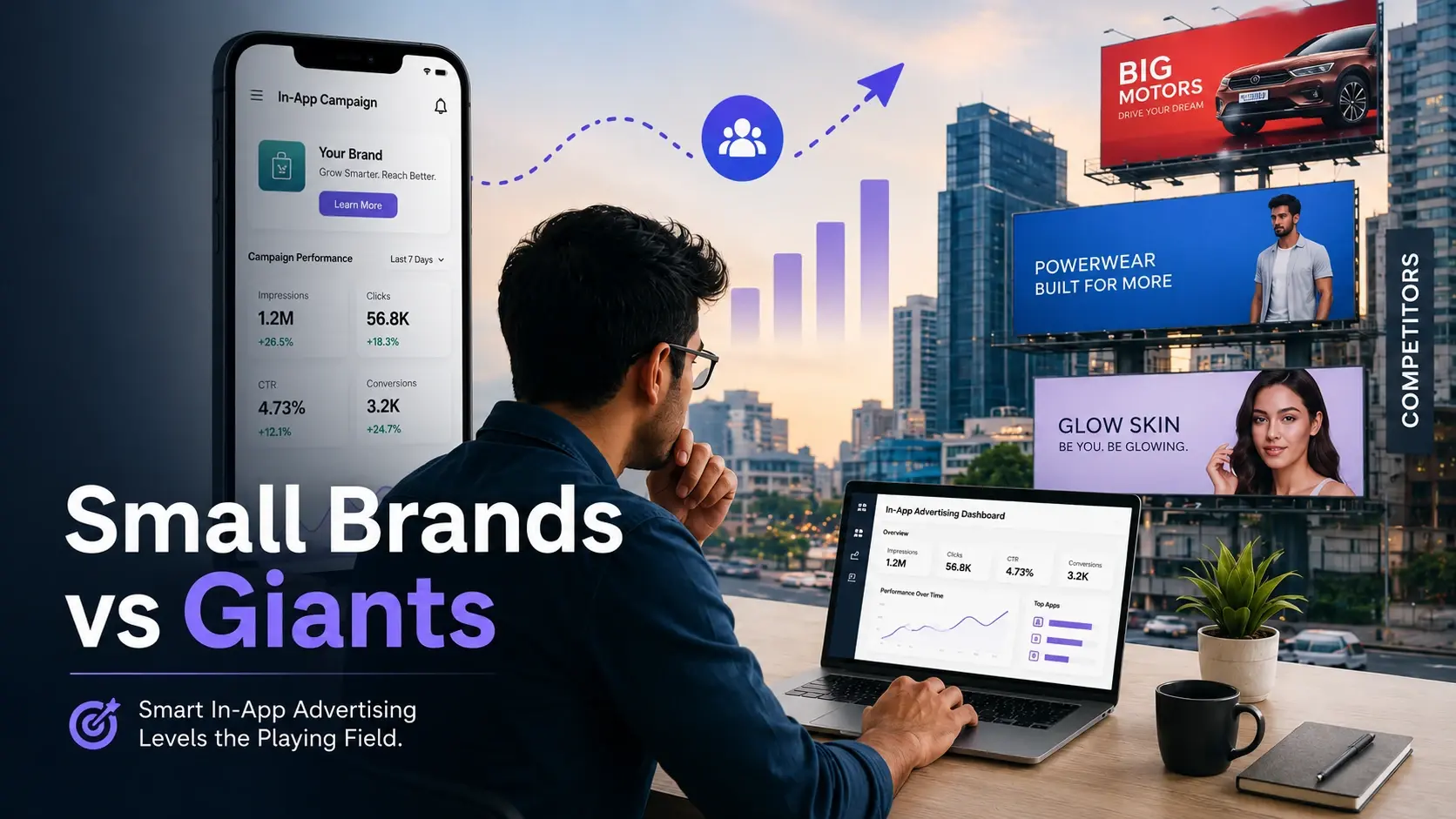
Big brands have large budgets, national visibility, celebrity campaigns, and years of customer trust. For small brands, competing with them can feel difficult. But digital advertising has changed the game. Today, small and growing businesses do not need massive media budgets to reach the right audience. With in-app advertising, they can target users with precision, control ad spending, measure performance, and scale campaigns faster.
In-app ads appear inside mobile applications such as shopping apps, entertainment apps, fintech apps, news apps, food delivery apps, gaming apps, and local service platforms. Since users spend a large part of their digital time on mobile apps, this format gives small brands a powerful opportunity to reach customers where they are most active.
EraZero supports in-app advertising along with OOH, transit, TV, radio, cinema, print, and other ad formats through one AI-powered advertising platform, helping brands manage campaigns from a unified dashboard.
Why In-App Ads Work for Small Brands
Small brands often cannot afford broad, mass-market advertising. The advantage of in-app ads is that they do not require brands to target everyone. Instead, they allow businesses to reach specific users based on location, behavior, interest, app category, and campaign goals.
For example, a D2C skincare brand can advertise inside beauty, shopping, or lifestyle apps. A local food brand can run ads on food delivery or hyperlocal apps. A fintech startup can reach users through finance, news, and utility apps. This makes mobile app advertising more focused and cost-effective than traditional mass advertising.
In-app advertising also offers multiple ad formats such as banner ads, native ads, video ads, interstitial ads, and rewarded ads. EraZero’s own in-app advertising content explains these formats and how brands can use them for engagement, CTR, and campaign performance.

1. Use Precise Audience Targeting
The biggest strength of in-app advertising is targeting. Small brands can compete with giants by reaching a smaller but more relevant audience.
Instead of spending money on broad visibility, small brands can target users by:
- City or pin code
- Age group
- Interest category
- App usage behavior
- Purchase intent
- Device type
- Time of day
- Local market preference
This allows small businesses to avoid wasteful spending. A regional fashion brand, for example, can target young urban shoppers in specific cities instead of running expensive national campaigns.
2. Start with Hyperlocal Campaigns
Big brands usually aim for national reach. Small brands can win by going local first. Hyperlocal in-app advertising helps brands build strong visibility in a specific city, neighborhood, or service area.
A cloud kitchen can promote offers to users within a delivery radius. A salon chain can target customers near its branches. A retail store can run app ads around a new location. This local focus helps small brands get faster conversions and stronger recall.
Hyperlocal campaigns are especially useful for small businesses because they reduce media wastage and improve relevance.
3. Choose the Right Ad Format
Not every in-app ad format works for every goal. Small brands should choose formats based on what they want to achieve.
For awareness, video ads and interstitial ads can work well because they capture attention. For app downloads or website visits, banner ads and native ads can drive clicks. For offers, sales, and coupon campaigns, rewarded ads can encourage action.
Native ads are useful when brands want a less disruptive user experience. Video ads are useful when storytelling matters. Banner ads are good for budget-friendly reach.
The right format helps small brands look professional, even with limited budgets.

4. Focus on Creative That Feels Clear and Useful
Small brands cannot always outspend large competitors, but they can outsmart them with better messaging. In-app ad creatives should be simple, direct, and benefit-driven.
A strong in-app ad should include:
- One clear message
- A strong visual
- A specific offer or benefit
- A direct call-to-action
- Mobile-friendly design
- Brand name and logo visibility
Instead of saying “Best skincare products,” a small brand can say “Get glowing skin in 7 days — Shop now.” Instead of “Download our finance app,” a fintech startup can say “Track expenses in 2 minutes — Download free.”
Clear messaging improves clicks, recall, and conversions.
5. Use AI to Plan Smarter Campaigns
Large brands often have media teams, agencies, and analytics experts. Small brands may not have those resources. This is where AI-powered advertising platforms can help.
EraZero’s Brand Tech AI platform is positioned to help brands plan, launch, and track in-app and other advertising campaigns with AI-led recommendations, campaign management, and performance tracking.
With AI-powered campaign planning, small brands can make better decisions about audience selection, ad formats, budget allocation, and performance optimization. Instead of guessing which app or format will work, brands can use data-backed suggestions.
6. Track Performance in Real Time
Traditional advertising can be difficult to measure. In-app advertising gives small brands access to performance metrics such as impressions, clicks, CTR, conversions, app installs, website visits, and engagement.
This helps businesses understand what is working and what needs improvement.
For example, if a banner ad is getting impressions but not clicks, the creative or call-to-action may need to change. If a video ad is driving high engagement, the brand can increase budget for that format. Real-time optimization helps small brands use every rupee more efficiently.
7. Combine In-App Ads with OOH or Transit Media
Small brands can also compete by creating a 360-degree brand experience. A customer may see a brand on a metro panel, bus shelter, or billboard, and later see the same brand inside a mobile app. This combination improves recall and trust.
EraZero highlights the ability to manage In-App, OOH, DOOH, and Transit media from one dashboard, making it easier for brands to combine digital and offline visibility.
For small brands, this creates a big-brand feel without needing a giant advertising budget.
8. Test, Learn, and Scale
Small brands should not start with huge campaigns. The better strategy is to test small, measure results, and then scale.
Start with one city, one audience segment, and two or three creatives. Track which ad performs best. Then increase spending on the best-performing format, location, or audience group.
This test-and-scale approach helps small brands grow safely and avoid costly mistakes.
AI-powered Planning for In-app Advertising
Small brands no longer need to compete with giants only through budget. With in-app advertising, they can compete through smart targeting, strong creatives, AI-powered planning, and real-time optimization.
In-app ads allow small businesses to reach the right users, control costs, test campaigns, and scale based on performance. Whether the goal is brand awareness, app downloads, website traffic, store visits, or sales, in-app advertising gives small brands a practical way to grow in a competitive market.
With platforms like EraZero, brands can simplify campaign planning, manage multiple ad formats, and make advertising smarter. For small brands ready to compete with bigger players, in-app ads are not just an option — they are a growth opportunity.