Launching a new product is expensive when awareness and availability don’t meet at the same moment. A consumer may see your social ad today, remember the product tomorrow, then discover it isn’t easy to buy when the craving finally hits.
That gap is where quick commerce advertising becomes valuable.
For FMCG, D2C, and food and beverage brands, platforms such as Blinkit and Zepto can place a new SKU in front of shoppers while they’re already browsing, searching, comparing, or adding products to their basket. A strong launch uses quick commerce as the point where discovery becomes trial.
Table of Contents
- Why quick commerce works for launches
- The seven-step launch playbook
- Blinkit and Zepto across the funnel
- A three-phase launch plan
- What EraZero’s campaign experience teaches us
- FAQs and next steps
Why Quick Commerce Works for New Product Launches
Traditional product launch marketing often starts with creators, social media, OOH, PR, sampling, or paid search. These channels can create curiosity, but they can leave a gap between “I want to try this” and “I can get it now.”
Quick commerce shortens that gap.
A shopper opening a grocery or essentials app is already in a buying environment. That makes the channel useful for new flavors, beverages, snacks, personal care, trial packs, and other frequently purchased categories.
The goal is to make the new SKU easy to discover and add to cart.
The Seven-Step Quick Commerce Launch Playbook
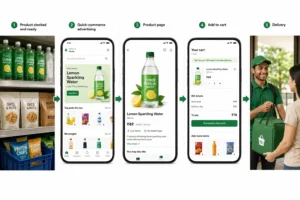
1. Start with availability, not advertising
Before spending on media, confirm where the product is actually live.
Map:
- Cities and delivery zones
- Stock depth
- Hero SKUs and pack sizes
- Pricing and promotional readiness
- Ability to replenish quickly
There is little value in creating demand where the product repeatedly appears unavailable. Your media map should follow your distribution map.
2. Pick one primary launch objective
Don’t ask one campaign to do everything.
Choose a priority such as:
- Product discovery
- First-time trial
- Add-to-cart growth
- Sales velocity
- Category entry
- Repeat purchase
3. Fix the digital shelf
The ad can win the click, but the product page has to finish the job.
Review:
- Pack image
- Product title
- Benefit-led description
- Pricing
- Offer visibility
- Category placement
- Search relevance
- Ratings and reviews where available
4. Match formats to the shopper journey
Use high-visibility banners or discovery placements to introduce the product. Use sponsored listings and search placements when shoppers are already exploring the category. Add physical touchpoints when trial matters.
EraZero’s quick commerce advertising offering includes product sampling, order inserts, carry-bag branding, pamphlet distribution, hyperlocal targeting, and structured campaign reporting.
5. Launch market by market
A concentrated launch often teaches you more than a broad rollout.
Prioritize cities, pin codes, and neighborhoods where you already have strong distribution, relevant audience density, and operational ability to maintain stock.
This is where hyperlocal quick commerce advertising can make the launch more efficient.
6. Give people a reason to try now
Newness creates curiosity. A clear trigger creates action.
Test:
- Introductory pricing
- Trial packs
- Launch bundles
- Limited-period offers
- Coupons
- Product sampling
7. Measure before launch day
Decide your success metrics before the first impression runs.
Track:
- Impressions and clicks
- Product-page visits
- Add-to-cart rate
- Conversion rate
- Units sold
- Sales by geography
- Stock-outs
- Repeat purchase where available
The better question is not “Did we get impressions?” but “Did advertising move the product in the markets where we invested?”
Blinkit and Zepto Advertising Across the Funnel

Blinkit Advertising: Capture purchase intent
Blinkit’s Brand Central supports sponsored placements across search, category pages, recommendations, and brand-store environments. For a launch, Blinkit advertising can support discovery while also putting the SKU closer to high-intent shopping moments.
Start with the placements closest to your goal. Use broader visibility during the launch window, then shift more budget toward category and search-led placements as performance data develops.
This approach allows Blinkit advertising to play different roles through the launch instead of being treated as one fixed media buy.
Zepto Advertising: Build discovery around context
Zepto advertising can be useful for frequent, impulse-led, or convenience-driven categories. EraZero’s Zepto advertising solutions include banners, sponsored listings, video, display, and other placements across discovery and purchase journeys.
Context matters. A beverage, snack, breakfast product, or personal-care SKU may perform differently by time, location, category, and shopping occasion.
For brands using Zepto advertising, the creative shouldn’t simply announce “new product.” It should quickly answer why the shopper should add it to the basket now.
A Three-Phase Product Launch Marketing Plan
Phase 1: Build visibility
Around launch, focus on:
- Hero creative
- High-visibility placements
- Category presence
- Creators and social support
- Priority cities
Keep the message simple:
What is new? Why should I care? Where can I get it?
Phase 2: Drive trial
Once awareness exists, move closer to conversion with:
- Sponsored products
- Category and search placements
- Sampling
- Inserts
- Bundles
- Coupons
This is where quick commerce advertising moves from exposure to actual product experience.
Phase 3: Scale what sells
Compare:
- City performance
- SKU performance
- Conversion
- Stock availability
- Offer response
Move budget toward the locations and formats that are working instead of keeping the original plan fixed.
That makes product launch marketing more responsive to real customer behavior rather than assumptions made before launch.
What EraZero’s Quick-Commerce Campaign Experience Shows
EraZero has already executed measurable campaigns using Blinkit’s delivery ecosystem.
In its published South Bengaluru quick-commerce case study, EraZero used 100,000 targeted Blinkit flyer insertions with pincode-level targeting, daily distribution reporting, cart-image proof, and barcode-based attribution.
The campaign generated 300+ qualified enquiries and a ₹1.5 crore attributed property sale.
The campaign was for real estate, not FMCG, but the execution lesson transfers well to product launches: quick-commerce media can be planned around geography, audience quality, delivery, proof of execution, and measurable response.
For FMCG, D2C, and food and beverage brands, the same discipline can support:
- Product samples
- Coupon inserts
- New-product flyers
- In-app placements
- Hyperlocal activations
- Trial campaigns
- Delivery-based branding
Brands can also use EraZero’s AI media planning platform to structure audience, geography, media mix, creative, and execution in one planning workflow.
This is particularly useful when Blinkit advertising, Zepto advertising, sampling, social media, OOH, and other launch channels need to work as one connected campaign instead of separate media activities.
Next Steps: Launch Where the Purchase Can Happen
A stronger product launch connects the journey:
Availability → Discovery → Trial → Purchase → Repeat
Start by mapping live inventory. Pick priority cities. Fix the digital shelf. Choose placements by funnel stage. Add a reason to try. Then optimize based on actual product movement.
Good product launch marketing on quick commerce isn’t about appearing everywhere at once. It is about being visible in the right market, with stock available, at the moment a consumer is ready to try something new.
If you’re planning a new FMCG, D2C, snack, beverage, personal-care, or consumer product launch, EraZero can help build a quick commerce advertising plan across platforms, hyperlocal activations, sampling, inserts, and measurable campaign execution.