
Direct-to-consumer brands have traditionally built their customer base through social media, search advertising, influencers and performance marketing. These channels offer measurable clicks, conversions and customer acquisition costs, making them attractive to young brands with limited budgets.
However, a D2C brand eventually reaches a point where performance advertising alone may not deliver the next stage of growth. The same audiences are repeatedly targeted, creative fatigue increases, acquisition costs become harder to control and the brand struggles to reach consumers outside its existing digital ecosystem.
This is where TV advertising for D2C brands can still play an important role.
Television should not replace digital marketing. Instead, it can become the mass-reach layer that builds awareness, credibility and demand, while search, social media, in-app advertising and commerce platforms convert that demand into measurable sales.
Is Television Advertising Still Relevant for D2C Brands?
India’s media landscape is becoming increasingly digital, but television continues to offer significant scale. According to the 2026 FICCI-EY media and entertainment report, television reaches approximately 745 million people every week in India. Connected TV adoption has also increased to around 40 million units. Although linear television advertising revenue declined in 2025, combined linear and Connected TV advertising revenue remained broadly stable.
PwC has also projected that India’s television market will grow at approximately 4.2% between 2023 and 2028, potentially making India the world’s fourth-largest television market by 2028.
The question is therefore not whether television is disappearing. The more useful question is whether a D2C brand is ready to use television effectively.
When Should a D2C Brand Invest in TV Advertising?
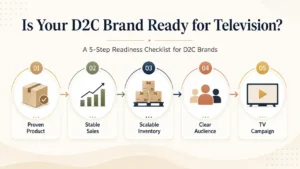
1. When the Product Has Broad Consumer Appeal
Mass reach advertising works best when the product is relevant to a large audience.
Categories such as skincare, personal care, food, beverages, health products, home care, fashion, financial services and consumer electronics can benefit from television because their potential customers are spread across multiple age groups, cities and household types.
A highly specialised product intended for a narrow professional audience may not need mass television reach. A shampoo, snack, mattress, beauty product or wellness brand, however, may find significant value in reaching millions of potential buyers quickly.
2. When the Brand Has Achieved Product-Market Fit
A brand should not use television to test whether people want its product.
Before launching a television ad campaign, the business should already have:
- Consistent customer demand
- Positive product reviews
- Reliable fulfilment capacity
- Healthy contribution margins
- A functional ecommerce website
- Sufficient inventory to manage increased demand
Television can amplify an existing growth engine, but it cannot repair weak products, poor delivery experiences or unclear brand positioning.
3. When Digital Customer Acquisition Begins to Plateau
Digital campaigns often perform strongly during the early growth stage because brands initially reach highly relevant audiences. Over time, those audience groups may become saturated.
The brand may notice rising customer acquisition costs, declining click-through rates, repeated exposure among the same users or slower growth despite increased digital spending.
TV can introduce the brand to consumers who may not have discovered it through social media or search. Increased television visibility can also create branded searches, direct website visits and stronger responses to later digital advertisements.
4. When Trust Is Important to the Purchase Decision
Many customers hesitate before purchasing from an unfamiliar D2C company, particularly in categories involving health, wellness, skincare, finance, children or premium-priced products.
Television can create a stronger perception of stability and credibility because consumers see the brand presented within established entertainment, news, sports or regional programming.
The combination of sight, sound and motion also allows a D2C brand to explain product benefits, demonstrate usage and communicate an emotional brand story more effectively than a small static advertisement.
5. When the Brand Is Entering New Markets
Television can support a major geographic expansion, product launch or festive campaign.
A D2C brand entering South India, for example, may not need an expensive national campaign. It can select regional entertainment, movie, news or language channels that match its target market.
Regional TV media planning can help brands build concentrated awareness in specific states before expanding further.
When TV Advertising May Not Be the Right Choice
A D2C brand may not be ready for television when it is still testing its product, has highly limited inventory or cannot clearly identify its target customer.
TV may also be unsuitable when the available budget is too small to maintain adequate frequency. Running a few scattered advertisements without sufficient repetition may create limited recall.
The brand should also delay television investment when it lacks a measurement framework. Without campaign tracking, the business may see an increase in sales but remain unable to determine whether television caused it.
Linear TV, Regional TV or Connected TV?
D2C brands no longer have to approach television as one uniform channel.
National linear television is suitable for brands with broad distribution and the ability to serve customers across India. It provides rapid reach but usually requires a larger budget.
Regional television is useful for city- or state-level growth. Brands can select channels according to language, geography, audience profile and programme genre.
Connected TV advertising is better suited to digitally active, urban and often premium households. It combines large-screen storytelling with targeting and measurement capabilities closer to digital advertising.
The right strategy may involve a combination. Linear or regional TV can generate scale, while Connected TV and in-app advertising can reach more defined audience groups.
How to Plan a D2C Television Ad Campaign
Start with one clear objective. The campaign may aim to increase brand awareness, support a new product launch, enter a new region or generate incremental sales.
Next, choose channels based on audience fit rather than popularity alone. Consider language, programme genre, location, viewer profile, time slot and campaign frequency.
The creative should focus on one memorable message. Avoid trying to explain every product feature in a 20- or 30-second advertisement. Show the problem, introduce the product, communicate the central benefit and end with a clear call to action.
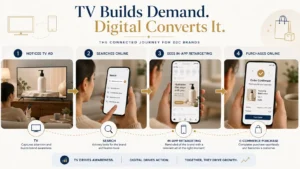
TV should then be integrated with digital and commerce channels. A viewer who sees the television advertisement may later search for the brand, encounter a mobile ad or discover the product on a shopping platform.
D2C brands can combine TV with quick commerce advertising, search campaigns, social retargeting, marketplace advertising and app-based placements. This turns television awareness into a connected customer journey.
How to Measure TV Advertising Performance
D2C brands should evaluate more than immediate television-attributed sales.
Useful campaign indicators include:
- Growth in branded search volume
- Direct website traffic
- New-user sessions during ad periods
- Sales uplift by advertised region
- Marketplace search and sales growth
- Promo code or QR-code usage
- Customer acquisition cost across all channels
- Brand awareness and recall studies
Brands can also compare advertised and non-advertised locations or analyse website activity immediately following television spots.
Plan Television Advertising with EraZero AI
EraZero helps brands plan and execute television advertising across national and regional channels.
Its approach includes strategic channel selection, audience-based planning, scheduling and centralised campaign execution. EraZero also brings television together with OOH, transit, radio, cinema, print, retail and digital media through one AI-powered advertising platform.
For a D2C brand, television makes the most sense when the business is ready to move from efficient customer acquisition to broader brand building. Used at the right stage—and connected with measurable digital channels—TV can help transform an online product into a recognised consumer brand.